資料確認:2026年10月14日
「今年はもうA型にかかったので、ワクチンは打たなくていいですか?」という疑問があります。一度つらい思いをすると、今季はもう大丈夫と思いたくなりますよね。
今季まだ接種していない方は、A型にかかった後も、回復してからワクチン接種を検討できます。A型にも種類があり、B型もあります。今回かかったウイルスへの免疫が、ほかの種類まで十分に守ってくれるとは限らないためです。[4]
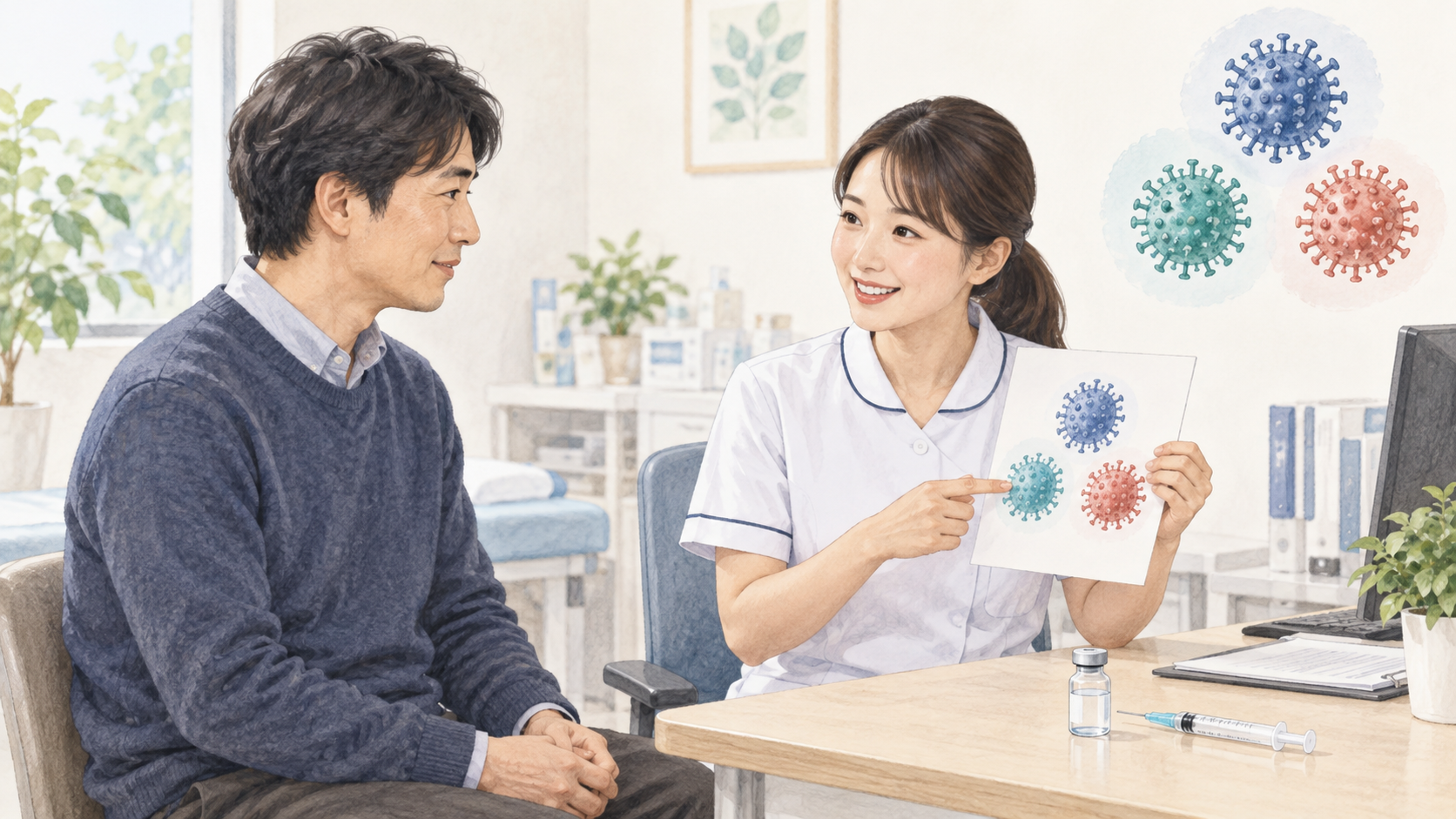
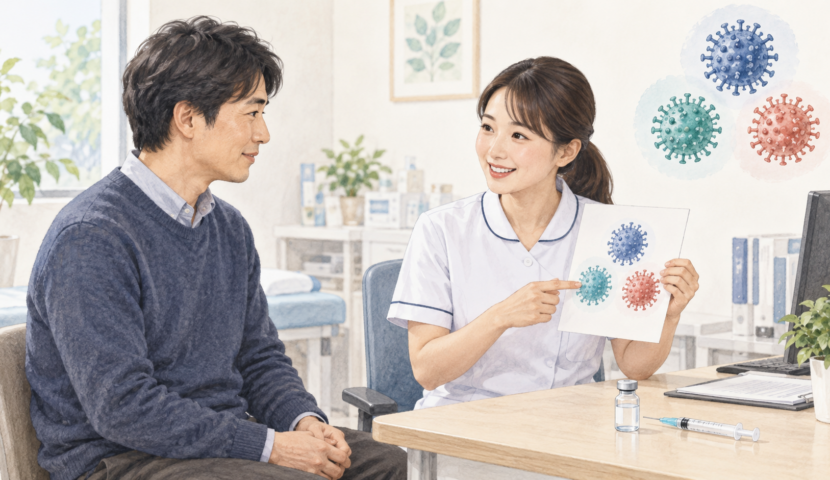
A型にかかっても、すべてのインフルエンザに免疫がつくわけではありません
季節性インフルエンザの主な種類は、A(H1N1)pdm09、A(H3N2)、B型(ビクトリア系統)です。H1N1とH3N2は、どちらもA型ですが、異なる亜型です。
一つのウイルスにかかった後は、それに対する免疫ができます。ただし、別の亜型やB型に対する免疫まで十分に得られるわけではありません。同じシーズンに別のインフルエンザにかかることもあります。[4]
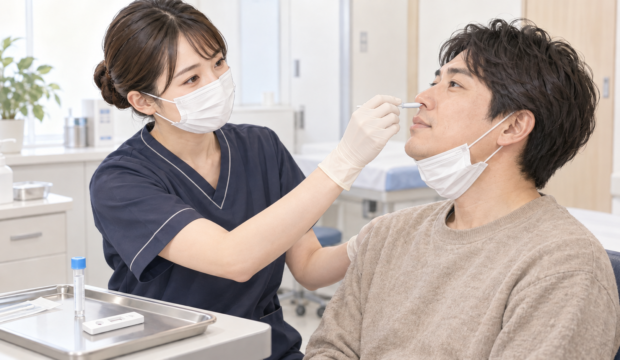
通常の迅速検査で「A型陽性」と分かっても、H1N1かH3N2かまでは区別しません。当院の鼻腔用パンビオもA型・B型を調べる検査です。「A型だった」という結果だけで、今回どの亜型にかかったかを断定することはできません。
今季のワクチンに含まれる3種類
2026/27シーズンの日本の注射用インフルエンザHAワクチンは3価です。「3価」は、3種類のウイルスに対応する成分を含む、という意味です。A型1種類・B型2種類ではなく、A型2種類・B型1種類です。[1]
B型の山形系統は今季の3価HAワクチンに含まれていません。製造株は次のとおりです。ここでいう「株」は、ワクチン製造に使うウイルスの具体的な名称です。
2026/27シーズンの注射用HAワクチン
- A(H1N1)pdm09A/スイス/6849/2025(IVR-278)
- A(H3N2)A/ミシガン/105/2025(SAN-049A)
- B型・ビクトリア系統B/東京/EIS13-175/2025
2026年秋、埼玉県で確認されている型は?
2026年10月14日に確認した埼玉県の資料では、第40週(9月28日~10月4日)の患者報告は3,461人、定点当たり19.66人で、流行注意報が発令中とされています。[2]
型を詳しく調べた県の病原体サーベイランスでは、第36~40週の集計(10月6日時点)はA(H1N1)pdm09が124件、A(H3N2)が5件、B型は0件でした。今秋のこの集計では、A型、とくにH1N1が中心です。これは提出された検体の検出数で、県内の全患者数や、当院の患者さんの内訳ではありません。[2][3]
昨冬の資料に出てくる「H3N2・サブクレードKが多い」という情報と、今秋の集計は分けて読む必要があります。埼玉県が公表した2025年第36~45週のH3N2の遺伝子解析では、解析した64件中63件がサブクレードKでしたが、この数字を今秋にそのまま当てはめることはできません。[2]
今はB型が検出されていなくても、冬から春まで同じ流行が続くとは限りません。今かかった型だけで、残りのシーズンの接種の必要性を決めないことが大切です。
治ってから、いつ接種すればよいですか?
発熱している間や、体調が十分に戻っていないときは、まず回復を優先します。明らかな発熱や重い急性疾患がある場合は接種に適しません。[6]
熱が下がり、普段の食事や生活に戻れるようになったら、接種時期をご相談ください。「感染したら必ず1か月待つ」といった一律の日数で決めるのではなく、回復の程度、年齢、持病、接種歴を確認して判断します。接種による免疫ができるまでには、通常約2週間かかります。ワクチンは、今かかっているインフルエンザを治す薬ではありません。[5][7]
予約時には「いつ発症したか」「いつ熱が下がったか」「今季のワクチンをすでに何回受けたか」をお知らせください。
接種を考える順番
- 今季の接種歴未接種か、必要な回数が残っているかを確認。
- 体調の回復発症日・解熱日・現在の症状を伝える。
- 回復後に接種を相談別の亜型やB型への備えを考える。
すでに接種した方や、お子さんの場合
今季の必要な接種を終えた方が、その後にA型にかかったからといって、通常さらに追加接種するわけではありません。今回は、今季まだ接種していない方、必要な回数が終わっていない方の相談が中心です。
国内の通常の注射用HAワクチンでは、6か月以上13歳未満は2回接種、13歳以上は一般に1回接種が基本です。使用製剤や医師の判断によって異なる場合があります。2回接種が必要なお子さんで、途中でインフルエンザにかかった場合も、感染を「ワクチン1回分」と数えず、回復後に残りの接種を相談します。[6]
高齢の方、腎臓病・糖尿病などの持病がある方、妊娠中の方は、重症化への備えも踏まえてご相談ください。過去の接種で強いアレルギー反応が出た方も、事前にお知らせください。[4][6]
「A型にかかったから不要?」への答え
今回かかったウイルスには免疫がついていますが、A型には別の亜型があり、B型もあります。まだ今季の接種を受けていなければ、体調が戻ってからワクチンを検討しましょう。
ワクチンには、発症の可能性を下げ、重症化を減らす意義があります。効果の程度は年齢や流行するウイルスとの一致などで変わりますが、一度かかったことだけを理由に、ほかの種類への備えまでやめる必要はありません。[5]
当院ではインフルエンザの予防接種を行っています。接種歴と回復状況を確認し、今季の接種についてご案内します。予約はWebからお進みいただけます。
参考資料
- 厚生労働省:令和8年度インフルエンザHAワクチン製造株の決定(2026年6月4日)
- 埼玉県:インフルエンザ流行情報・病原体サーベイランス(2026年10月7日掲載、検出集計10月6日時点)
- 埼玉県:2026年第36~40週の年齢階級別・型別検出数(公式Excel)
- CDC / ACIP:2024–25 influenza vaccination recommendations — vaccination after illness
- CDC:Key Facts About Seasonal Flu Vaccine — benefits and time to develop protection
- PMDA:インフルエンザHAワクチン「生研」電子添文(2026年7月、第10版)※国内HAワクチンの例
- CDC:Clinical Guidance for Seasonal Influenza Vaccine Safety
Sources checked: 14 October 2026
“I have already had influenza A this season. Do I still need a flu vaccine?” After being ill, it is understandable to hope that you are protected for the rest of the season.
If you have not yet been vaccinated this season, vaccination remains worth considering after recovery. Influenza A has different subtypes, and influenza B also circulates. Immunity from your recent infection may not adequately protect against the other viruses.[4]
One infection does not cover every influenza virus
The main seasonal viruses are A(H1N1)pdm09, A(H3N2), and influenza B of the Victoria lineage. H1N1 and H3N2 are both type A but are different subtypes.
Infection produces immunity to the virus involved, but this does not mean adequate protection against another subtype or type B. A different influenza infection can occur in the same season.[4]
A usual rapid test result of “influenza A positive” does not distinguish H1N1 from H3N2. Our nasal Panbio test also identifies A and B, rather than these A subtypes. The result alone cannot tell you which subtype caused your illness.
Three components in Japan’s 2026/27 vaccine
Japan’s injectable influenza HA vaccine for 2026/27 is trivalent: it contains components for three viruses, specifically two A subtypes and one B lineage, not one A and two B components.[1]
B/Yamagata is not included in this season’s trivalent HA vaccine. The manufacturing strains are shown below; a “strain” is the specific virus used to manufacture that component.
Japan’s injectable HA vaccine, 2026/27
- A(H1N1)pdm09A/Switzerland/6849/2025 (IVR-278)
- A(H3N2)A/Michigan/105/2025 (SAN-049A)
- B/Victoria lineageB/Tokyo/EIS13-175/2025
What is circulating in Saitama this autumn?
In the Saitama information checked on 14 October 2026, week 40 (28 September–4 October) recorded 3,461 reported patients, or 19.66 per sentinel clinic, with an influenza advisory in effect.[2]
The prefecture’s pathogen surveillance for weeks 36–40, as compiled on 6 October, found 124 A(H1N1)pdm09, five A(H3N2), and no influenza B. A, particularly H1N1, predominated in this early-autumn sample. These are detections in submitted specimens, not counts of every patient in Saitama or at our clinic.[2][3]
Last winter’s H3N2/subclade K findings are a different time period. In Saitama’s genetic analysis of H3N2 from weeks 36–45 of 2025, 63 of 64 analysed specimens were subclade K. Those findings should not be presented as this autumn’s distribution.[2]
No B detections now does not establish what will circulate throughout winter and spring. The virus you recently had should not be the only basis for the rest of your season’s vaccination plan.
When can I be vaccinated after recovery?
Recover first if you have a fever or are still significantly unwell. Clear fever or a serious acute illness makes vaccination inappropriate at that time.[6]
Once your fever has settled and you can return to usual eating and daily activities, discuss timing. There is no blanket requirement to wait one month after influenza. The clinician reviews recovery, age, underlying conditions and vaccination history. Vaccine protection usually takes about two weeks to develop; the vaccine does not treat the current infection.[5][7]
Please tell us when symptoms began, when fever resolved, and how many doses you have already received this season.
Planning vaccination
- Vaccination historyCheck whether unvaccinated or doses remain due.
- RecoveryReport onset, fever resolution and current symptoms.
- Discuss vaccinationPrepare for other subtypes and influenza B.
Already vaccinated, or booking for a child?
If you have completed this season’s required doses, catching influenza A does not normally mean you need an extra dose. This discussion is mainly for people who are unvaccinated or have doses still due.
With usual injectable HA vaccines in Japan, children aged six months to under 13 receive two doses; people aged 13 or older generally receive one. The product and clinician’s assessment may affect the plan. If a child catches influenza between doses, infection does not count as a vaccine dose; discuss the remaining dose after recovery.[6]
Older people, those with kidney disease or diabetes, and pregnant people should also consider their risk of severe illness. Tell us about any previous severe allergic reaction to vaccination.[4][6]
The answer to “Is vaccination unnecessary after A?”
You have immunity to the virus that caused this infection, but other influenza A subtypes and influenza B remain relevant. If you have not yet been vaccinated this season, consider vaccination once you recover.
Vaccination can reduce influenza illness and severe outcomes. The degree of protection varies with age and the circulating viruses, but a previous infection alone is not a reason to abandon protection against the other viruses.[5]
Our clinic offers influenza vaccination. We review your recovery and vaccination history, and you can proceed to online booking.
References
- 厚生労働省:令和8年度インフルエンザHAワクチン製造株の決定(2026年6月4日)
- 埼玉県:インフルエンザ流行情報・病原体サーベイランス(2026年10月7日掲載、検出集計10月6日時点)
- 埼玉県:2026年第36~40週の年齢階級別・型別検出数(公式Excel)
- CDC / ACIP:2024–25 influenza vaccination recommendations — vaccination after illness
- CDC:Key Facts About Seasonal Flu Vaccine — benefits and time to develop protection
- PMDA:インフルエンザHAワクチン「生研」電子添文(2026年7月、第10版)※国内HAワクチンの例
- CDC:Clinical Guidance for Seasonal Influenza Vaccine Safety
资料核对日期:2026年10月14日
“这一季已经得过甲型流感,还需要打流感疫苗吗?”经历了一次生病,想安心度过剩下的季节是很自然的。
如果本季还没有接种,康复后仍值得考虑接种。甲型流感有不同亚型,也有乙型流感。此次感染形成的免疫,不一定能充分保护您免受其他病毒的感染。[4]
一次感染并不能覆盖所有流感病毒
主要的季节性流感病毒有甲型A(H1N1)pdm09、甲型A(H3N2)、乙型B(Victoria系)。H1N1和H3N2都属于甲型,但亚型不同。
感染后会对该病毒产生免疫,但不代表对另一亚型或乙型也有充分保护。同一季内也可能感染另一种流感病毒。[4]
普通快速检测报告“甲型阳性”,通常并不区分H1N1和H3N2。本院鼻腔用Panbio也检测甲型和乙型,而不区分甲型亚型。因此,仅凭“甲型阳性”无法确定此次感染的具体亚型。
日本2026/27季疫苗的三种成分
日本2026/27季的注射用HA流感疫苗为三价,即含三种病毒成分:两种甲型、一种乙型,不是一种甲型和两种乙型。[1]
本季三价HA疫苗不含乙型Yamagata系。下方列出制造株。“株”指用于制造疫苗的具体病毒名称。
日本2026/27季注射用HA流感疫苗
- 甲型A(H1N1)pdm09A/Switzerland/6849/2025 (IVR-278)
- 甲型A(H3N2)A/Michigan/105/2025 (SAN-049A)
- 乙型B/Victoria系B/Tokyo/EIS13-175/2025
2026年秋季埼玉县的流行情况
截至2026年10月14日所核对的埼玉县资料,第40周(9月28日至10月4日)报告患者3,461人,每个哨点19.66人,并发布流感流行注意报。[2]
县病原体监测第36至40周的汇总(10月6日时点)显示,A(H1N1)pdm09为124例、A(H3N2)为5例、乙型为0例。这份初秋样本以甲型、尤其H1N1为主。这些是提交样本的检出数,不是全县或本院全部患者的统计。[2][3]
上一冬季的H3N2及K亚分支数据属于另一个时期。埼玉县对2025年第36至45周H3N2样本进行遗传分析,64份中63份属于K亚分支,不能直接当成今年秋季的分布。[2]
目前没有检出乙型,不代表整个冬春季都不会流行。不要仅根据此次感染的类型决定剩余季节是否接种。
康复后什么时候可以接种?
仍有发热或明显不适时,先以康复为主。明显发热或严重急性疾病时不适合接种。[6]
退热并恢复日常饮食、生活后,可咨询接种时间。并非感染后都必须等一个月。医生会根据恢复程度、年龄、基础疾病和接种史判断。接种后通常约两周形成保护;疫苗不能治疗正在发生的流感。[5][7]
预约时请告知发病日期、退热日期,以及本季已接种的次数。
接种前的确认顺序
- 确认本季接种史尚未接种,或仍有剂次未完成。
- 确认身体恢复告知发病、退热日期及目前症状。
- 康复后咨询接种防备其他亚型及乙型流感。
已接种者和儿童的注意事项
如果已经完成本季所需接种,之后得了甲型流感,通常不因此额外补打一针。本文主要针对本季尚未接种或未完成所需剂次的人。
日本常规注射用HA疫苗,6个月至未满13岁通常接种两次,13岁及以上一般一次,具体取决于制剂和医生判断。儿童在两针之间感染,感染不能算作一次疫苗接种,康复后仍应咨询剩余剂次。[6]
对“得过甲型就不用打?”的回答
您对这次感染的病毒已形成免疫,但还有其他甲型亚型和乙型流感。如果本季尚未接种,可在康复后考虑疫苗。
疫苗有助于降低发病和重症风险。保护程度随年龄和流行病毒等因素变化,但不能仅因得过一次就放弃对其他病毒的防备。[5]
本院提供流感疫苗接种,确认恢复情况及接种史后进行安排,可通过网络预约。
参考资料
- 厚生労働省:令和8年度インフルエンザHAワクチン製造株の決定(2026年6月4日)
- 埼玉県:インフルエンザ流行情報・病原体サーベイランス(2026年10月7日掲載、検出集計10月6日時点)
- 埼玉県:2026年第36~40週の年齢階級別・型別検出数(公式Excel)
- CDC / ACIP:2024–25 influenza vaccination recommendations — vaccination after illness
- CDC:Key Facts About Seasonal Flu Vaccine — benefits and time to develop protection
- PMDA:インフルエンザHAワクチン「生研」電子添文(2026年7月、第10版)※国内HAワクチンの例
- CDC:Clinical Guidance for Seasonal Influenza Vaccine Safety
Fuentes revisadas: 14 de octubre de 2026
“Ya he pasado la gripe A esta temporada. ¿Todavía necesito vacunarme?” Tras enfermar, es comprensible pensar que ya estará protegido el resto de la temporada.
Si aún no se ha vacunado esta temporada, merece la pena plantearlo después de recuperarse. Hay distintos subtipos de gripe A y también gripe B. La inmunidad frente a la infección reciente puede no proteger suficientemente frente a los demás virus.[4]
Una infección no protege frente a todos los virus de la gripe
Los principales virus estacionales son A(H1N1)pdm09, A(H3N2) y B del linaje Victoria. H1N1 y H3N2 son de tipo A, pero de subtipos diferentes.
La infección genera inmunidad frente al virus implicado, pero no garantiza protección suficiente frente a otro subtipo o al tipo B. Es posible pasar otra gripe en la misma temporada.[4]
Un resultado habitual de prueba rápida “gripe A positiva” no distingue H1N1 de H3N2. Nuestro Panbio nasal también identifica A y B, no estos subtipos A. El resultado por sí solo no permite saber cuál causó la enfermedad.
Los tres componentes de la vacuna japonesa de 2026/27
La vacuna HA inyectable de Japón para 2026/27 es trivalente: incluye tres componentes, dos del tipo A y uno del tipo B, no uno A y dos B.[1]
El linaje B/Yamagata no está incluido. A continuación se indican las cepas de fabricación, es decir, los virus concretos utilizados para elaborar sus componentes.
Vacuna HA inyectable de Japón, temporada 2026/27
- A(H1N1)pdm09A/Switzerland/6849/2025 (IVR-278)
- A(H3N2)A/Michigan/105/2025 (SAN-049A)
- B, linaje VictoriaB/Tokyo/EIS13-175/2025
Qué circula en Saitama en otoño de 2026
La información de Saitama revisada el 14 de octubre de 2026 señala 3.461 pacientes notificados, 19,66 por centro centinela, en la semana 40 (28 de septiembre–4 de octubre), con un aviso de circulación de gripe en vigor.[2]
La vigilancia de patógenos de las semanas 36–40, recopilada al 6 de octubre, detectó 124 A(H1N1)pdm09, cinco A(H3N2) y ningún B. En esa muestra de principios de otoño predominó A, especialmente H1N1. Son detecciones en muestras enviadas, no el total de pacientes de la prefectura ni de nuestra clínica.[2][3]
Los datos del invierno anterior sobre H3N2 y el subclado K pertenecen a otro periodo. En el análisis de Saitama de muestras H3N2 de las semanas 36–45 de 2025, 63 de 64 fueron del subclado K; esa distribución no debe trasladarse a este otoño.[2]
Que ahora no se detecte B no predice todo el invierno y la primavera. No decida la vacunación del resto de la temporada solo por el virus que acaba de pasar.
Cuándo vacunarse después de la gripe
Si sigue con fiebre o claramente enfermo, primero debe recuperarse. La fiebre manifiesta o una enfermedad aguda grave hacen que ese momento no sea adecuado para vacunarse.[6]
Cuando haya desaparecido la fiebre y vuelva a comer y hacer sus actividades habituales, consulte. No existe una obligación general de esperar un mes tras la gripe. Se valoran recuperación, edad, enfermedades previas y vacunación. La protección suele tardar unas dos semanas en desarrollarse; la vacuna no trata la infección actual.[5][7]
Indique cuándo comenzaron los síntomas, cuándo se resolvió la fiebre y cuántas dosis ha recibido esta temporada.
Cómo planificar la vacunación
- Dosis esta temporadaComprobar si falta la vacuna o alguna dosis.
- RecuperaciónComunicar inicio, fin de la fiebre y síntomas actuales.
- Consulta sobre la vacunaPrepararse frente a otros subtipos y la gripe B.
Si ya está vacunado o se trata de un niño
Si ha completado las dosis necesarias de esta temporada, pasar después la gripe A no suele requerir otra dosis. Esta explicación se dirige sobre todo a quienes aún no se han vacunado o tienen dosis pendientes.
Con las vacunas HA inyectables habituales en Japón, de seis meses a menos de 13 años se administran dos dosis; a partir de 13 años suele ser una. Puede variar según el producto y la valoración médica. Si un niño enferma entre dosis, la infección no cuenta como una dosis de vacuna; consulte sobre la dosis pendiente tras la recuperación.[6]
Las personas mayores, con enfermedad renal o diabetes, y las embarazadas deben considerar también su riesgo de complicaciones. Informe de cualquier reacción alérgica grave a una vacuna anterior.[4][6]
La respuesta a “¿Ya no necesito vacuna después de A?”
La infección le ha dado inmunidad frente al virus que la causó, pero existen otros subtipos A y la gripe B. Si aún no se ha vacunado esta temporada, plantéelo cuando se recupere.
La vacunación puede reducir la gripe y sus formas graves. El grado de protección varía con la edad y los virus circulantes, pero haber pasado una infección no es razón suficiente para abandonar la protección frente a los demás.[5]
Nuestra clínica ofrece vacunación antigripal. Revisamos la recuperación y las dosis previas; puede reservar por internet.
Referencias
- 厚生労働省:令和8年度インフルエンザHAワクチン製造株の決定(2026年6月4日)
- 埼玉県:インフルエンザ流行情報・病原体サーベイランス(2026年10月7日掲載、検出集計10月6日時点)
- 埼玉県:2026年第36~40週の年齢階級別・型別検出数(公式Excel)
- CDC / ACIP:2024–25 influenza vaccination recommendations — vaccination after illness
- CDC:Key Facts About Seasonal Flu Vaccine — benefits and time to develop protection
- PMDA:インフルエンザHAワクチン「生研」電子添文(2026年7月、第10版)※国内HAワクチンの例
- CDC:Clinical Guidance for Seasonal Influenza Vaccine Safety
자료 확인: 2026년 10월 14일
“이번 시즌에 이미 A형 독감에 걸렸는데 백신을 맞아야 하나요?” 한 번 아팠다면 남은 시즌에는 괜찮겠다고 생각하기 쉽습니다.
이번 시즌에 아직 접종하지 않았다면 회복 후에도 예방접종을 고려할 수 있습니다.A형에는 여러 아형이 있고 B형도 있습니다. 이번 감염으로 생긴 면역이 다른 바이러스까지 충분히 막아 주는 것은 아닙니다.[4]
한 번의 감염으로 모든 독감에 면역이 생기지는 않습니다
주요 계절성 독감 바이러스는 A(H1N1)pdm09, A(H3N2), B형 빅토리아 계통입니다. H1N1과 H3N2는 모두 A형이지만 서로 다른 아형입니다.
감염된 바이러스에 대한 면역은 생기지만 다른 아형이나 B형에도 충분한 보호가 생긴다는 뜻은 아닙니다. 같은 시즌에 다른 독감에 걸릴 수도 있습니다.[4]
일반적인 신속검사에서 “A형 양성”이 나와도 H1N1과 H3N2는 구별하지 않습니다. 본원 비강용 Panbio도 A형과 B형을 검사하며 A형 아형을 나누지 않습니다. 결과만으로 이번 감염의 아형을 단정할 수 없습니다.
일본 2026/27 시즌 백신의 세 성분
일본의 2026/27 시즌 주사용 HA 독감 백신은 3가입니다. 세 바이러스 성분, 즉 A형 2종과 B형 1종을 포함한다는 뜻이며 A형 1종과 B형 2종이 아닙니다.[1]
B형 야마가타 계통은 이번 3가 HA 백신에 포함되지 않습니다. 아래의 제조주는 백신 제조에 사용하는 구체적인 바이러스 이름입니다.
일본 2026/27 시즌 주사용 HA 독감 백신
- A(H1N1)pdm09A/Switzerland/6849/2025 (IVR-278)
- A(H3N2)A/Michigan/105/2025 (SAN-049A)
- B형 빅토리아 계통B/Tokyo/EIS13-175/2025
2026년 가을 사이타마현의 유행
2026년 10월 14일 확인한 사이타마현 자료에서 40주차(9월 28일~10월 4일) 환자 보고는 3,461명, 감시 의료기관당 19.66명으로 유행 주의보가 발령 중입니다.[2]
현의 병원체 감시 36~40주차 집계(10월 6일 기준)는 A(H1N1)pdm09 124건, A(H3N2) 5건, B형 0건입니다. 이 초가을 표본에서는 A형, 특히 H1N1이 중심입니다. 제출 검체의 검출 수이며 현 전체 환자나 본원 환자의 구성은 아닙니다.[2][3]
지난겨울 H3N2·하위분기 K의 자료는 다른 기간입니다. 사이타마현의 2025년 36~45주차 H3N2 유전자 분석에서 64건 중 63건이 K였지만 이를 이번 가을의 분포로 사용해서는 안 됩니다.[2]
지금 B형이 검출되지 않았다고 겨울과 봄에도 없다는 뜻은 아닙니다. 이번 감염의 형만으로 남은 시즌의 접종을 결정하지 마세요.
회복 후 언제 접종할 수 있나요?
열이 있거나 아직 많이 아프면 회복을 우선합니다. 뚜렷한 발열이나 중증 급성 질환이 있을 때는 접종에 적절하지 않습니다.[6]
열이 내리고 평소 식사와 생활로 돌아오면 접종 시기를 상담하세요. 독감 후 반드시 한 달을 기다려야 한다는 일률적인 규칙은 없습니다.회복 정도, 나이, 기저질환, 접종력을 확인합니다. 접종 후 보호 면역이 생기는 데는 보통 약 2주가 걸리며 현재의 독감을 치료하는 백신은 아닙니다.[5][7]
예약할 때 증상 시작일, 해열일, 이번 시즌 접종 횟수를 알려 주세요.
접종을 계획하는 순서
- 이번 시즌 접종력미접종 또는 남은 접종 횟수를 확인합니다.
- 회복 확인발병일·해열일·현재 증상을 전달합니다.
- 회복 후 접종 상담다른 아형과 B형에 대비합니다.
이미 접종한 분과 어린이
이번 시즌 필요한 접종을 마쳤다면 이후 A형에 걸렸다고 보통 추가로 접종하지는 않습니다. 아직 접종하지 않았거나 필요한 횟수가 남은 분을 위한 설명입니다.
일본의 일반적인 주사용 HA 백신은 생후 6개월 이상 13세 미만은 2회, 13세 이상은 대개 1회이며 제제와 의사의 판단에 따라 달라질 수 있습니다. 어린이가 접종 사이에 독감에 걸려도 감염을 백신 1회로 세지 않고 회복 후 남은 접종을 상담합니다.[6]
고령자, 신장질환·당뇨병 환자, 임신 중인 분은 중증 위험도 고려하세요. 이전 접종에 심한 알레르기 반응이 있었다면 미리 알려 주세요.[4][6]
“A형에 걸렸으니 안 맞아도 되나요?”에 대한 답
이번 감염의 바이러스에는 면역이 생겼지만 다른 A형 아형과 B형도 있습니다. 이번 시즌 아직 접종하지 않았다면 회복 후 백신을 고려하세요.
백신은 발병과 중증 위험을 줄이는 데 의미가 있습니다. 나이와 유행 바이러스에 따라 효과는 달라지지만 한 번 걸렸다는 이유만으로 다른 바이러스에 대한 대비까지 포기할 필요는 없습니다.[5]
본원은 독감 예방접종을 시행합니다. 회복과 접종력을 확인해 안내하며 온라인으로 예약할 수 있습니다.
참고 자료
- 厚生労働省:令和8年度インフルエンザHAワクチン製造株の決定(2026年6月4日)
- 埼玉県:インフルエンザ流行情報・病原体サーベイランス(2026年10月7日掲載、検出集計10月6日時点)
- 埼玉県:2026年第36~40週の年齢階級別・型別検出数(公式Excel)
- CDC / ACIP:2024–25 influenza vaccination recommendations — vaccination after illness
- CDC:Key Facts About Seasonal Flu Vaccine — benefits and time to develop protection
- PMDA:インフルエンザHAワクチン「生研」電子添文(2026年7月、第10版)※国内HAワクチンの例
- CDC:Clinical Guidance for Seasonal Influenza Vaccine Safety
資料確認:2026年10月14日
「A型にかかったので接種は不要ですか」と聞かれたら、罹患歴と接種歴を分けて確認します。今回の感染で得られた免疫は意味がありますが、すべての季節性インフルエンザをカバーするものではありません。
未接種者には、回復後の接種を提案できます。ACIPの2024/25勧告も、今季すでに罹患した未接種者に、ほかの流行ウイルスへの防御を目的とする接種を勧めています。国内で実際に使う製剤の適応・用法は日本の電子添文で確認します。[4][6]
罹患で得られる免疫と、3価ワクチンの役割
感染後は原因ウイルスへの免疫応答が生じますが、A(H1N1)pdm09とA(H3N2)は別の亜型、B(ビクトリア系統)は別の型・系統です。感染免疫を「今季の全型への免疫」と説明しないようにします。
2026/27シーズンの国内注射用HAワクチンはA2株・B1株の3価です。HAはウイルス表面のヘマグルチニンというタンパク質で、ワクチンはこれに対する免疫を誘導します。自然感染歴があっても、他のワクチン成分への予防を考える余地がある、という説明です。[1][6]
この国内製造株一覧は注射用HAワクチンの説明です。経鼻生ワクチンや海外製剤の株・接種回数へそのまま当てはめません。
2026/27シーズンの注射用HAワクチン
- A(H1N1)pdm09A/スイス/6849/2025(IVR-278)
- A(H3N2)A/ミシガン/105/2025(SAN-049A)
- B型・ビクトリア系統B/東京/EIS13-175/2025
迅速検査のA陽性を、亜型確定として扱わない
当院の鼻腔用PanbioはインフルエンザA/Bの判定で、H1N1/H3N2の亜型診断ではありません。問診で「A型陽性」と聞いたときは、確認できた範囲を記録し、流行の中心だけを根拠に個人の亜型を確定しないようにします。
「B型だけに意味がある」と説明を狭めず、別のA亜型も含めた備えとして伝えます。同じ亜型内にも変異があり、感染歴もワクチンも完全な防御を保証するものではありませんが、説明の主眼は接種をやめる理由探しではなく、残る予防の意義です。[4][5]
流行データは、季節・地域・分母をそろえて読む
埼玉県第40週(2026年9月28日~10月4日)の定点報告は3,461人、定点当たり19.66人。一方、10月6日時点の第36~40週の病原体検出集計はH1N1pdm09 124件、H3N2 5件、B 0件です。患者報告数と検体の検出数は分母が違います。型別割合を県内全患者へ直接拡大しません。[2][3]
2025年第36~45週のH3N2遺伝子解析64件中63件がサブクレードKという県の情報は、昨季の亜型のさらに細かい遺伝的グループの話です。今秋H1N1が多い集計と混同しません。[2]
初秋のB検出0件は、シーズン後半のB流行を否定しません。資料の集計日・検体採取週を示し、公開時にも再確認します。今回のデータ確認日は2026年10月14日です。
回復後の接種判断と、確認しておきたいこと
- 回復:発症日、解熱日、呼吸器症状、食事・活動、合併症の有無。
- 接種歴:今季の製剤、接種日、回数。罹患は接種回数に数えません。
- 背景:年齢、腎疾患・糖尿病などの持病、妊娠、免疫抑制治療。
- 副反応歴:アナフィラキシーなど。医師へ共有して個別に判断します。
明らかな発熱や重篤な急性疾患は国内HAワクチンの接種不適当状態です。回復後は一律の「感染後1か月」を設けず、全身状態と診察で判断します。接種後の免疫形成に通常約2週間を要する点も説明します。[5][6][7]
発症中の治療や感染対策を、ワクチン相談で置き換えないことも大切です。
接種を考える順番
- 罹患歴・接種歴検査の判定範囲と必要回数を確認。
- 回復と接種適否全身状態・持病・副反応歴を医師へ共有。
- 接種と説明他の亜型・型への備えと免疫形成期間を伝える。
子どもの未完了接種と、成人の追加接種を分ける
通常の国内注射用HA製剤では6か月以上13歳未満は2回、13歳以上は1回または2回という承認用法で、一般に成人は1回です。製剤ごとの用法、年齢、接種間隔を確認します。添文の例では小児の2回間隔は2~4週、免疫効果から4週が望ましいとされています。[6]
2回接種の途中の感染を「2回目の代わり」としません。回復後の残りの接種を医師に確認します。今季の必要接種を完了した成人には、A感染後の追加ブースターを通常の対応として案内しません。未接種者への提案と区別します。
患者さんへ説明する言葉
「今回のA型に対する免疫はついています。ただ、A型には別の種類があり、B型もあるため、今季まだ打っていなければ回復後の接種には意味があります。いつ熱が下がったか、これまで何回打ったかを一緒に確認しましょう。」
CDC/ACIPの罹患後接種の記載は、他の流行ウイルスへの防御という推奨の根拠です。「罹患後の接種で何%追加予防できる」といった、この資料にない効果量は付けません。国内料金・助成も年齢や自治体で異なるため、未確認の金額はこの記事に記載していません。
当院の検査方法と予防接種案内につなぎ、接種の可否と時期を診察で決められるようにします。
参考資料
- 厚生労働省:令和8年度インフルエンザHAワクチン製造株の決定(2026年6月4日)
- 埼玉県:インフルエンザ流行情報・病原体サーベイランス(2026年10月7日掲載、検出集計10月6日時点)
- 埼玉県:2026年第36~40週の年齢階級別・型別検出数(公式Excel)
- CDC / ACIP:2024–25 influenza vaccination recommendations — vaccination after illness
- CDC:Key Facts About Seasonal Flu Vaccine — benefits and time to develop protection
- PMDA:インフルエンザHAワクチン「生研」電子添文(2026年7月、第10版)※国内HAワクチンの例
- CDC:Clinical Guidance for Seasonal Influenza Vaccine Safety
Sources checked: 14 October 2026
When someone asks whether influenza A makes vaccination unnecessary, review illness history separately from vaccination history. Infection-induced immunity is meaningful, but it does not cover all seasonal influenza viruses.
Offer unvaccinated patients a discussion of vaccination after recovery. The 2024/25 ACIP recommendations specifically include previously infected, unvaccinated people because vaccination may protect against other circulating viruses. Use the Japanese product information for the vaccine actually administered.[4][6]
Infection-induced immunity and the trivalent vaccine
A(H1N1)pdm09 and A(H3N2) are different subtypes, and B/Victoria is another type/lineage. Do not describe immunity after one infection as immunity to all seasonal viruses.
Japan’s injectable HA vaccine for 2026/27 has two A strains and one B strain. HA, haemagglutinin, is a viral surface protein targeted by the immune response. A previous infection still leaves a reason to consider protection against the other vaccine components.[1][6]
The manufacturing strains below apply to Japan’s injectable HA vaccine. Do not automatically extend the list or dose schedule to intranasal live vaccines or overseas products.
Japan’s injectable HA vaccine, 2026/27
- A(H1N1)pdm09A/Switzerland/6849/2025 (IVR-278)
- A(H3N2)A/Michigan/105/2025 (SAN-049A)
- B/Victoria lineageB/Tokyo/EIS13-175/2025
Do not interpret an A rapid test as confirmed subtyping
Our nasal Panbio identifies influenza A/B, not H1N1/H3N2. Document what was actually established. The locally predominant subtype is not a laboratory confirmation of an individual patient’s subtype.
Avoid narrowing the benefit to “B only”; another A subtype is relevant too. Variation also occurs within subtypes. Neither infection nor vaccination guarantees complete protection, but counselling should explain the remaining value of prevention rather than search for a reason to stop it.[4][5]
Read surveillance by period, region and denominator
Saitama’s week 40 of 2026 (28 September–4 October) recorded 3,461 reported patients, 19.66 per sentinel. Separately, pathogen surveillance for weeks 36–40, compiled on 6 October, detected 124 H1N1pdm09, five H3N2 and no B. Patient reports and tested specimens have different denominators. Do not generalise the subtype proportions to every patient in the prefecture.[2][3]
The prefecture’s finding of subclade K in 63 of 64 sequenced H3N2 specimens from weeks 36–45 of 2025 belongs to last season. A subclade is a finer genetic grouping within a subtype. Do not conflate it with this autumn’s H1N1-heavy sample.[2]
No B detections early in the season does not exclude later B circulation. Record collection weeks and compilation dates, and recheck at publication. Sources for this article were checked on 14 October 2026.
Recovery and pre-vaccination assessment
- Recovery: onset, fever resolution, respiratory symptoms, eating/activity and complications.
- Vaccination: product, dates and doses this season; infection is not a dose.
- Background: age, kidney disease or diabetes, pregnancy and immunosuppression.
- Adverse reactions: previous anaphylaxis or other relevant history for clinician review.
Clear fever or a serious acute illness makes vaccination inappropriate under Japanese HA product information. After recovery, there is no blanket “one month after infection” rule; assess the patient’s current condition. Explain that immune protection usually develops over about two weeks.[5][6][7]
A vaccination discussion must not replace treatment or infection-control measures during acute illness.
Planning vaccination
- Illness and dosesConfirm the test’s scope and remaining doses.
- Recovery and suitabilityShare condition, risks and adverse reactions with the clinician.
- Vaccination and counsellingExplain other viruses and the time to develop protection.
Incomplete childhood doses versus extra adult doses
Usual Japanese injectable HA vaccines specify two doses from six months to under 13 years, and one or two from age 13; adults generally receive one. Check the specific product, age and interval. The example Japanese insert specifies 2–4 weeks between the paediatric doses and prefers four weeks for immune effect.[6]
Infection between two planned doses is not a substitute for the second dose. Ask the clinician about completion after recovery. Do not routinely offer an extra post-infection booster to adults who have already completed the season’s necessary vaccination; distinguish this from recommending vaccination to someone still unvaccinated.
Practical counselling
“This infection has given you immunity to that virus. But other A subtypes and influenza B remain relevant. If you have not yet been vaccinated this season, vaccination can still be useful after recovery. Let us check when your fever settled and which doses you have already received.”
The ACIP recommendation supports protection against other circulating viruses; it does not provide a numerical additional effectiveness estimate specifically after infection. Do not invent one. Unverified prices and subsidies are also omitted because these depend on age and municipality.
Connect the patient to our testing and vaccination information, with suitability and timing decided clinically.
References
- 厚生労働省:令和8年度インフルエンザHAワクチン製造株の決定(2026年6月4日)
- 埼玉県:インフルエンザ流行情報・病原体サーベイランス(2026年10月7日掲載、検出集計10月6日時点)
- 埼玉県:2026年第36~40週の年齢階級別・型別検出数(公式Excel)
- CDC / ACIP:2024–25 influenza vaccination recommendations — vaccination after illness
- CDC:Key Facts About Seasonal Flu Vaccine — benefits and time to develop protection
- PMDA:インフルエンザHAワクチン「生研」電子添文(2026年7月、第10版)※国内HAワクチンの例
- CDC:Clinical Guidance for Seasonal Influenza Vaccine Safety