資料確認:2026年10月15日
検査で分かる割合は、発症からの時間によって変わります。複数のキットをまとめて評価した研究をもとに、検査の目安、発症時間の数え方、陰性だったあとの対応を説明します。
時間がたつと、検査で見つかる人が増えていきます
● + 赤:検出できた人
○ − 青:検出できなかった人
症状が出た直後
まだ見つかりにくい時期
12時間以内
陽性になる人が増えてきます
24時間以内
さらに見つかりやすくなります
48時間以内
時間がたっても陰性の人がいます
陰性でも症状が続くときは、経過をみて再診・必要な再検査を。
複数のキットをまとめた、時間別の検出率
国内の病院1施設・クリニック3施設で、6種類の迅速抗原検査をまとめて評価した研究があります。413人を解析し、A型インフルエンザが確認された人のうち、抗原検査で検出できた割合を、発症からの時間ごとに調べています。[7]
- 12時間未満:75.6%(127人中96人)
- 12〜24時間:89.4%(47人中42人)
- 24〜48時間:82.6%(23人中19人)
この研究では、発症から半日未満で約7〜8割、半日〜2日では約8〜9割が検出されています。検出率は、時間や症状の強さ、検体の採取状態なども含めた診療の条件によって変わります。[7]
ほかの研究も合わせて読むと、発症して間もない時期には陰性になることがあり、時間をおいて検出される方がいることが分かります。研究ごとの患者さんや発症時間の数え方には違いがあるため、半日〜1日を目安に、結果とその後の経過を合わせて判断します。[1][5][6][7]
検査の目安は、半日〜1日後
症状が軽く、状態が安定している方が検査の予定を立てるなら、発症から半日(12時間)以上、できれば1日(24時間)前後を一つの目安としてお勧めします。発症直後はウイルスの量が少なく、抗原検査で捉えにくい場合があるためです。[2][7]
高齢の方、妊娠中の方、小さなお子さん、持病がある方や、症状が強い方は、この時間を待たずに相談してください。抗ウイルス薬は早い開始が重視されるため、検査の時刻にこだわって必要な治療を遅らせないことが大切です。[3][4]
「発熱から」と「最初の症状から」は違います
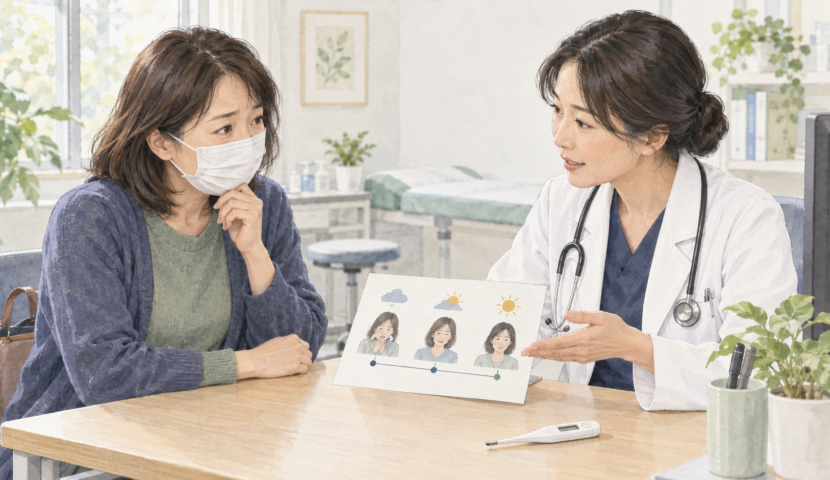
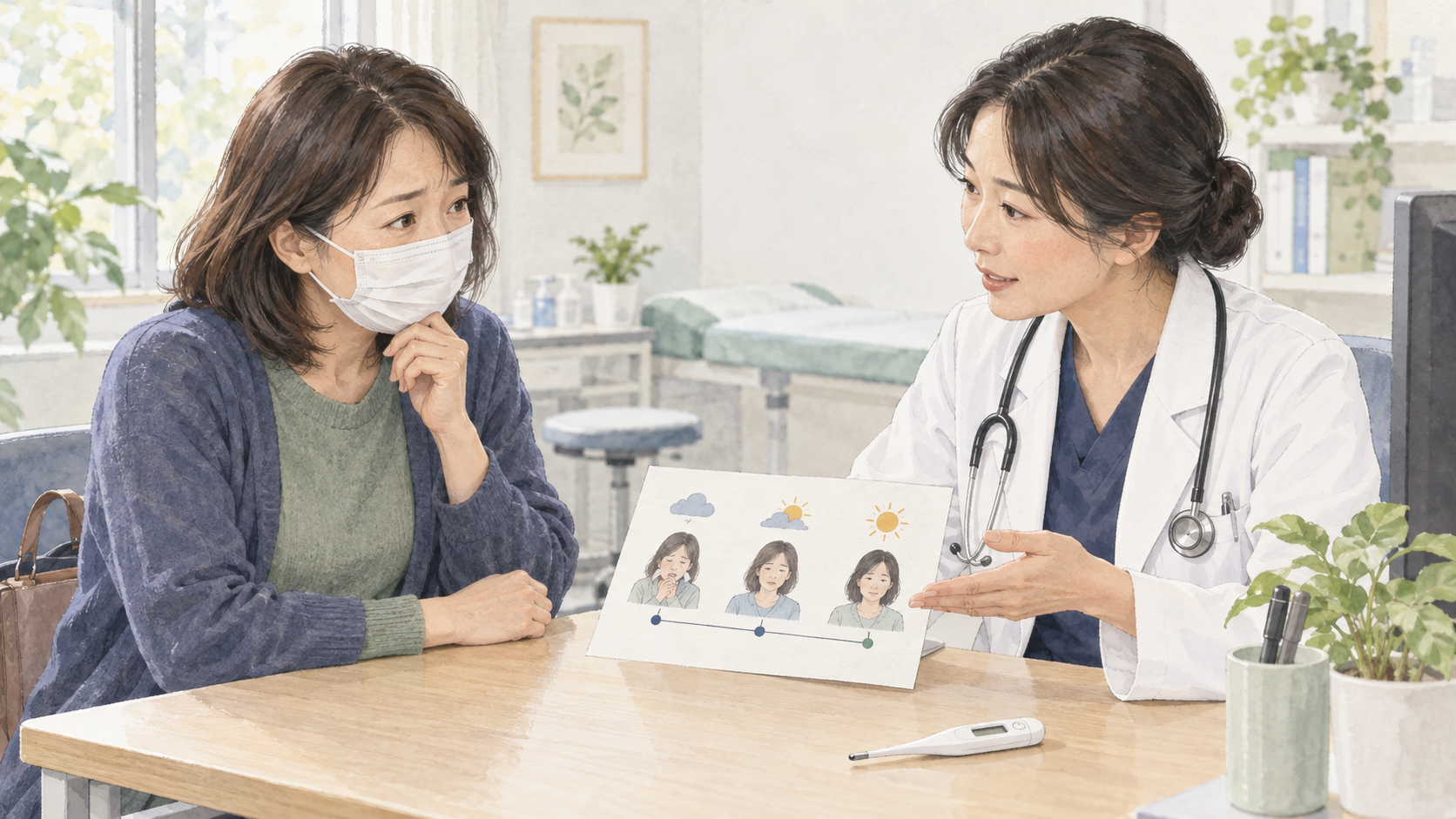
発熱は始まった時刻が分かりやすい症状ですが、その前から少し喉が痛い、だるいと感じることもあります。軽い症状から数えた12時間と、発熱から数えた12時間は、同じではありません。
時間の数え方の例
朝8時に少し喉が痛くなり、午後4時に発熱。午後8時に検査した場合、喉の痛みからは12時間ですが、発熱からはまだ4時間です。
この例では、喉の痛みから半日たっていても、発熱してからは間もないため、抗原検査で捉えられる量のウイルスがまだ十分に増えていないことがあります。
受診時には、最初に体調の変化を感じた時刻と、熱が出た時刻を分けて伝えてください。
軽い症状から数えると、陽性になるまで長くかかることも
喉の痛みなどが発熱より先に出た場合、そこから数えると、検査が陽性になるまでの時間も長くなります。「軽い症状から半日たったから、もう十分に検出できるはず」とは限りません。症状が軽く安定している方では、発熱した時刻や、その後の症状の変化も踏まえて検査の時期を考えます。
明石らの国内研究も、発熱だけでなく、喉の痛みや咳、だるさなど最初の症状から時間を数えています。その数え方では、24時間以降の群で、より多くの感染者が抗原検査で陽性になっていました。[1]
この研究から日常の受診に生かしたいのは、軽い症状から数えた時間には、発熱前の時間も含まれるという点です。初回の検査が陰性でも、熱や症状が続く場合は、その後の経過を確認し、必要に応じて再検査します。
補足:最初の症状から時間を数えた研究のグラフとデータ
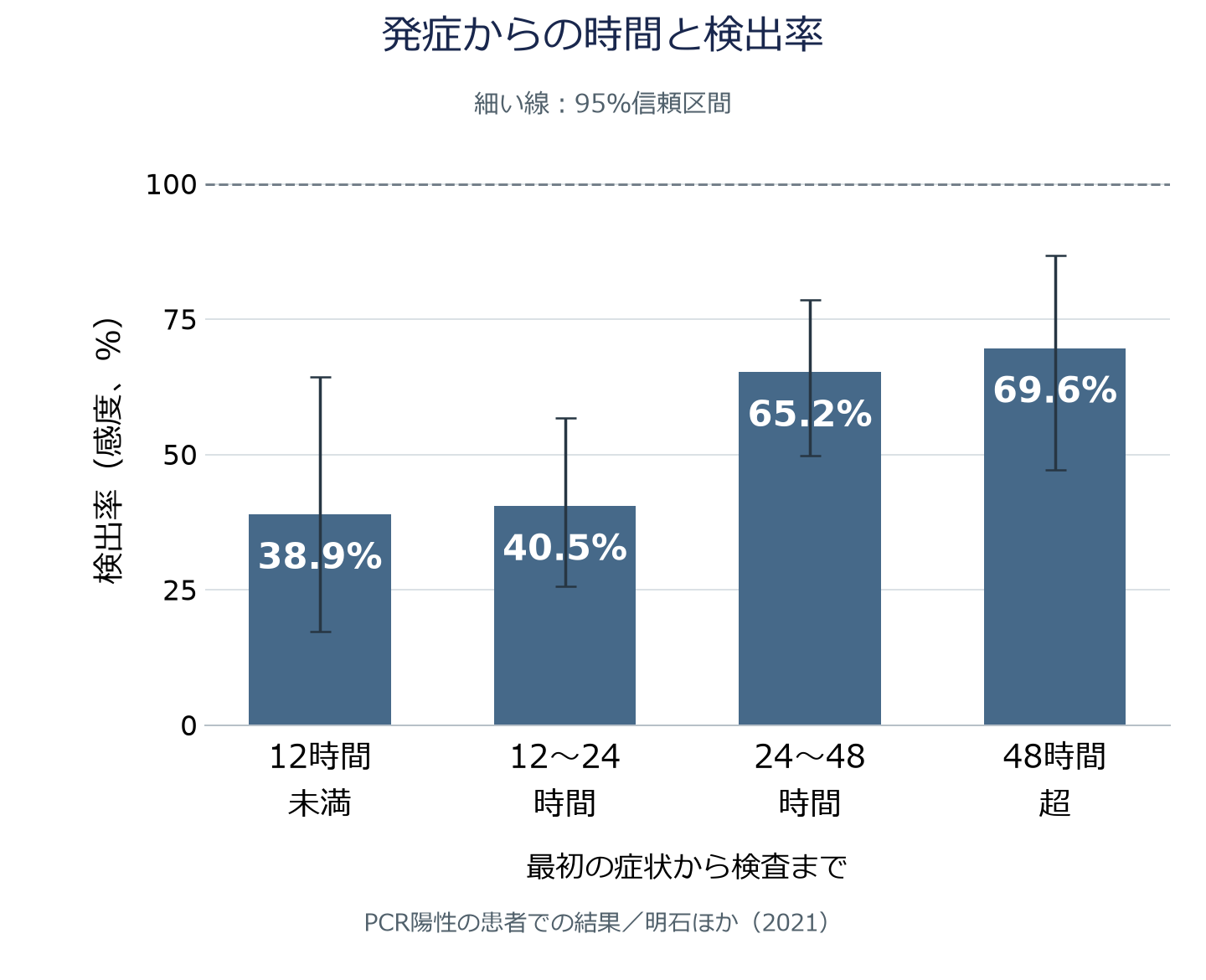
筑波メディカルセンター病院で2017~2019年の流行期に実施された研究です。313人を解析し、129人がPCR陽性でした。鼻咽頭から採取した検体で迅速抗原検査を行いました。
| 発症からの時間 | 検出率(95%信頼区間) |
|---|---|
| 12時間未満 | 38.9% 17.3~64.3% |
| 12~24時間 | 40.5% 25.6~56.7% |
| 24~48時間 | 65.2% 49.8~78.6% |
| 48時間超 | 69.6% 47.1~86.8% |
各時間帯のPCR陽性患者で、抗原検査が検出した割合です。異なる患者群を時間帯ごとに比較しています。95%信頼区間は推定の幅を示します。
検査を待たずに相談したい場合もあります
息苦しい、意識や反応がおかしい、水分が取れず尿が少ない、いったん良くなった熱や咳が再び悪化した場合は、再検査の予定を待たず受診してください。[4]
高齢の方、妊娠中の方、小さなお子さん、持病がある方などは、早めの相談が必要です。抗インフルエンザ薬は一般に早期の開始が重視され、医師が症状や重症化リスクから、検査が陰性でも治療を検討することがあります。陽性になるまで待ち続けることが目的ではありません。[3][4]
陰性だったら、その後の経過と再検査が大切です
半日〜1日たって検査しても、陰性になることがあります。熱や症状が続く場合は、もう一度受診してください。前回からの変化を確認し、必要な再検査や治療につなげます。[2]
再診では、必要に応じて時間をおいた再検査や別の検査方法を検討し、ほかの病気も含めて評価します。翌日に陽性になったという変化だけで、最初の採取が悪かったとは判断できません。[2]
陰性だったあとの確認
- 初回の診察結果とともに、発症時刻・症状・持病を確認。
- 経過を確認熱・呼吸・水分摂取などの変化を記録。
- 必要な方は再診再検査・別の検査・治療を医師が判断。
再検査の時期や方法は、症状、初回検査からの時間、持病や治療の必要性を合わせて決めます。
最初の症状、発熱、検査の時刻と、その後の体温・水分摂取・呼吸の変化を伝えてください。大切なのは、確実な結果が出る時刻を待ち続けることではなく、受診時の結果と、その後の経過を診療につなげることです。
参考資料
- 明石祐作ほか.発症から検査までの時間がインフルエンザ迅速抗原検査に与える影響:前向き観察研究.感染症学雑誌 2021;95:9–16(Table 2A)
- CDC. Rapid Influenza Diagnostic Tests
- CDC. Influenza Antiviral Medications: Summary for Clinicians
- CDC. Signs and Symptoms of Flu
- Yu SH et al. Performance evaluation of the Panbio COVID-19/Flu A&B Panel using mid-turbinate nasal swabs. J Clin Microbiol. 2024. DOI: 10.1128/jcm.00207-24
- Seki Y et al. Very high sensitivity of a rapid influenza diagnostic test in adults and elderly individuals within 48 hours of the onset of illness. PLoS One. 2020;15:e0231217
- Mikamo H et al. Comparing the cobas Influenza A/B Nucleic acid test for use on the cobas Liat System with rapid antigen tests for clinical management of Japanese patients at the point of care. PLoS One. 2022;17:e0276099(Table 3)
Sources checked: 15 October 2026
Detection changes with time from onset. Using research that assessed several antigen kits together, we explain practical timing, how onset is counted, and what to do after a negative result.
More infections may be detected as time passes
● + Red: detected
○ − Blue: not detected
Just after symptoms start
Detection may still be difficult
Within 12 hours
More tests become positive
Within 24 hours
More infections may be found
Within 48 hours
Some tests can remain negative
If symptoms persist after a negative result, seek reassessment and repeat testing when needed.
Detection over time across several test kits
A Japanese study at one hospital and three clinics assessed six rapid antigen kits together. It analysed 413 people and measured detection among confirmed influenza A infections by time from onset.[7]
- Under 12 hours: 75.6% (96/127)
- 12–24 hours: 89.4% (42/47)
- 24–48 hours: 82.6% (19/23)
In this study, detection was roughly 70–80% before half a day and 80–90% between half a day and two days. Time, symptom severity and specimen collection all contribute to the observed rate.[7]
Read alongside other studies, these findings show that early tests can be negative and some infections become detectable later. Study populations and onset definitions vary. Use half a day to one day as a guide, and interpret results with the subsequent course.[1][5][6][7]
A practical guide: half a day to one day after onset
If symptoms are mild and your condition is stable, we suggest planning an antigen test after at least half a day (12 hours), preferably around one day (24 hours), as a practical guide. Very early viral amounts may be harder to detect. [2][7]
Older people, pregnant people, young children, people with underlying conditions or severe symptoms should seek advice without waiting for that time. Early antiviral treatment matters; do not delay needed treatment to fit a testing clock.[3][4]
Time from fever and time from the first symptom are different
Fever often has a clear starting time, but a mild sore throat or fatigue may come first. Twelve hours from a mild symptom is not the same as twelve hours from fever.
An example
A mild sore throat starts at 8 am, fever at 4 pm, and testing takes place at 8 pm. That is 12 hours from the sore throat, but only 4 hours from fever.
In this example, half a day has passed since the sore throat, yet fever has only recently begun. There may still be too little virus for an antigen test to detect.
Tell the clinic when the first symptom started and when fever began, separately.
Counting from mild symptoms can mean a longer time until a positive test
If a sore throat precedes fever, counting from that earlier symptom makes the measured time until a positive test longer. Half a day after a mild symptom does not necessarily mean enough time has passed for detection. For mild, stable illness, consider fever onset and the subsequent course when planning testing.
Akashi and colleagues counted from the first symptom, including sore throat, cough or fatigue, rather than fever alone. With that definition, antigen testing detected more infections in groups tested after 24 hours.[1]
The practical point is that time counted from a mild symptom includes the period before fever. If an initial test is negative and fever or symptoms persist, reassess the course and repeat testing when needed.
Further reading: graph and data counted from the first symptom
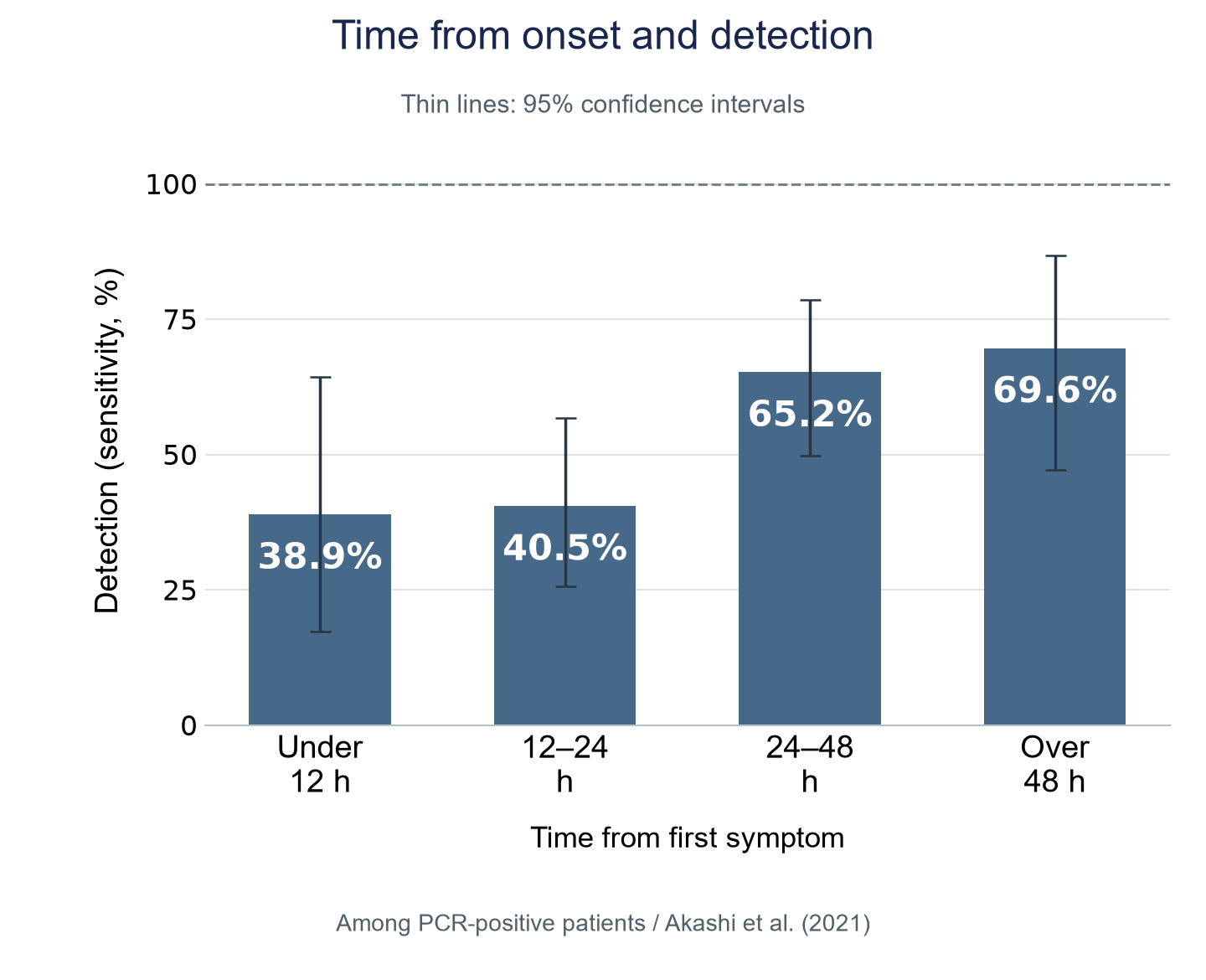
The study took place at Tsukuba Medical Center Hospital during the 2017–2019 influenza seasons. It analysed 313 people, of whom 129 were PCR-positive, using nasopharyngeal specimens for rapid antigen testing.
| Time from onset | Detection (95% confidence interval) |
|---|---|
| Under 12 h | 38.9% 17.3~64.3% |
| 12–24 h | 40.5% 25.6~56.7% |
| 24–48 h | 65.2% 49.8~78.6% |
| Over 48 h | 69.6% 47.1~86.8% |
These are antigen detection rates among PCR-positive patients in different time groups. The 95% confidence intervals show the range of uncertainty.
Sometimes care should not wait for another test
Seek prompt care for difficulty breathing, abnormal alertness, inability to drink with reduced urine, or fever/cough returning or worsening after initial improvement. Do not wait for a planned repeat test.[4]
Older people, pregnant people, young children and those with underlying illnesses should seek advice early. Early antiviral treatment matters; a clinician may treat suspected flu despite a negative result based on symptoms and risk. Waiting until a test becomes positive is not the aim.[3][4]
After a negative result, follow the course and reassess
A test can be negative even after 12–24 hours. If fever or symptoms persist, arrange another assessment. Review changes since the first visit and decide on further testing or treatment when needed.[2]
The clinician may choose repeat testing after an interval, another method or assessment for other illnesses. A positive result the next day does not alone prove that the first sample was collected poorly.[2]
After a negative result
- Initial assessmentReview onset, symptoms and underlying conditions with the result.
- Follow the courseRecord fever, breathing and fluid intake.
- Reassessment if neededThe clinician decides on repeat or different tests and treatment.
Symptoms, time since the first test, underlying conditions and treatment needs determine whether, when and how to retest.
Report first-symptom, fever and test times, together with changes in temperature, fluids and breathing. The aim is to use the initial result and subsequent course in care, rather than keep waiting for a moment of guaranteed certainty.
References
- 明石祐作ほか.発症から検査までの時間がインフルエンザ迅速抗原検査に与える影響:前向き観察研究.感染症学雑誌 2021;95:9–16(Table 2A)
- CDC. Rapid Influenza Diagnostic Tests
- CDC. Influenza Antiviral Medications: Summary for Clinicians
- CDC. Signs and Symptoms of Flu
- Yu SH et al. Performance evaluation of the Panbio COVID-19/Flu A&B Panel using mid-turbinate nasal swabs. J Clin Microbiol. 2024. DOI: 10.1128/jcm.00207-24
- Seki Y et al. Very high sensitivity of a rapid influenza diagnostic test in adults and elderly individuals within 48 hours of the onset of illness. PLoS One. 2020;15:e0231217
- Mikamo H et al. Comparing the cobas Influenza A/B Nucleic acid test for use on the cobas Liat System with rapid antigen tests for clinical management of Japanese patients at the point of care. PLoS One. 2022;17:e0276099(Table 3)
资料核对:2026年10月15日
检出比例会随起病后的时间变化。本文根据合并评估多种抗原试剂盒的研究,说明检测时间的参考、如何计算起病时间,以及阴性后的应对。
随着时间经过,可能检出更多感染者
● + 红色:已检出
○ − 蓝色:未检出
刚出现症状
此时可能较难检出
12小时以内
阳性的人逐渐增多
24小时以内
可能检出更多感染者
48小时以内
经过一段时间仍可能阴性
阴性后症状持续时,请复诊,必要时再次检测。
多种试剂盒合并评估的时间别检出率
日本一家医院和三家诊所合并评估6种快速抗原试剂盒,分析413人,并按起病后的时间统计确诊A型流感的人中抗原检出的比例。[7]
- 不足12小时:75.6%(96/127)
- 12~24小时:89.4%(42/47)
- 24~48小时:82.6%(19/23)
这一研究中,半天内约七至八成检出,半天至两天约八至九成。检测时间、症状轻重和采样状态都会影响实际检出率。[7]
结合其他研究,可了解发病早期可能阴性,有些人在稍后检出。研究的人群与起病时间定义不同,可把半天至一天作为参考,并结合结果和之后病程判断。[1][5][6][7]
检测时间的参考:半天至一天后
症状轻且状态稳定的人安排抗原检测时,本院建议把起病后至少半天(12小时)、最好约一天(24小时)作为参考。刚发病时病毒量可能较少,较难检出。[2][7]
老年人、孕妇、幼儿、有基础疾病或症状严重的人,不要为了等到这个时间而延迟咨询。抗病毒治疗重视早期开始,不能因检测时间而耽误必要治疗。[3][4]
从发热和从最初症状开始计时,并不相同
发热的开始时间通常容易记住,但轻微咽痛或乏力可能出现得更早。从轻微症状开始的12小时,不等于从发热开始的12小时。
计时的例子
早上8点轻微咽痛,下午4点发热,晚上8点检测:距离咽痛已12小时,但距离发热只有4小时。
这个例子中,虽然咽痛已半天,发热却刚开始不久,病毒量仍可能不足以被抗原检测检出。
就诊时请分别说明最初症状和发热开始的时间。
从轻微症状开始算,到阳性可能需要更长时间
如果咽痛先于发热,从较早的症状开始计时,到检测阳性的时间就会更长。不能认为轻微症状已过半天,就一定容易检出。症状轻、状态稳定的人,可结合发热的时间及之后的症状变化安排检测。
Akashi等的日本研究从咽痛、咳嗽、乏力等最初症状开始计时,而不只看发热。按这种定义,24小时以后的组中有更多感染者抗原阳性。[1]
就诊时应理解,从轻微症状开始的时间包含发热前的阶段。首次阴性后发热或症状持续,应复诊观察病程,必要时再次检测。
补充:从最初症状开始计时的研究图表及数据
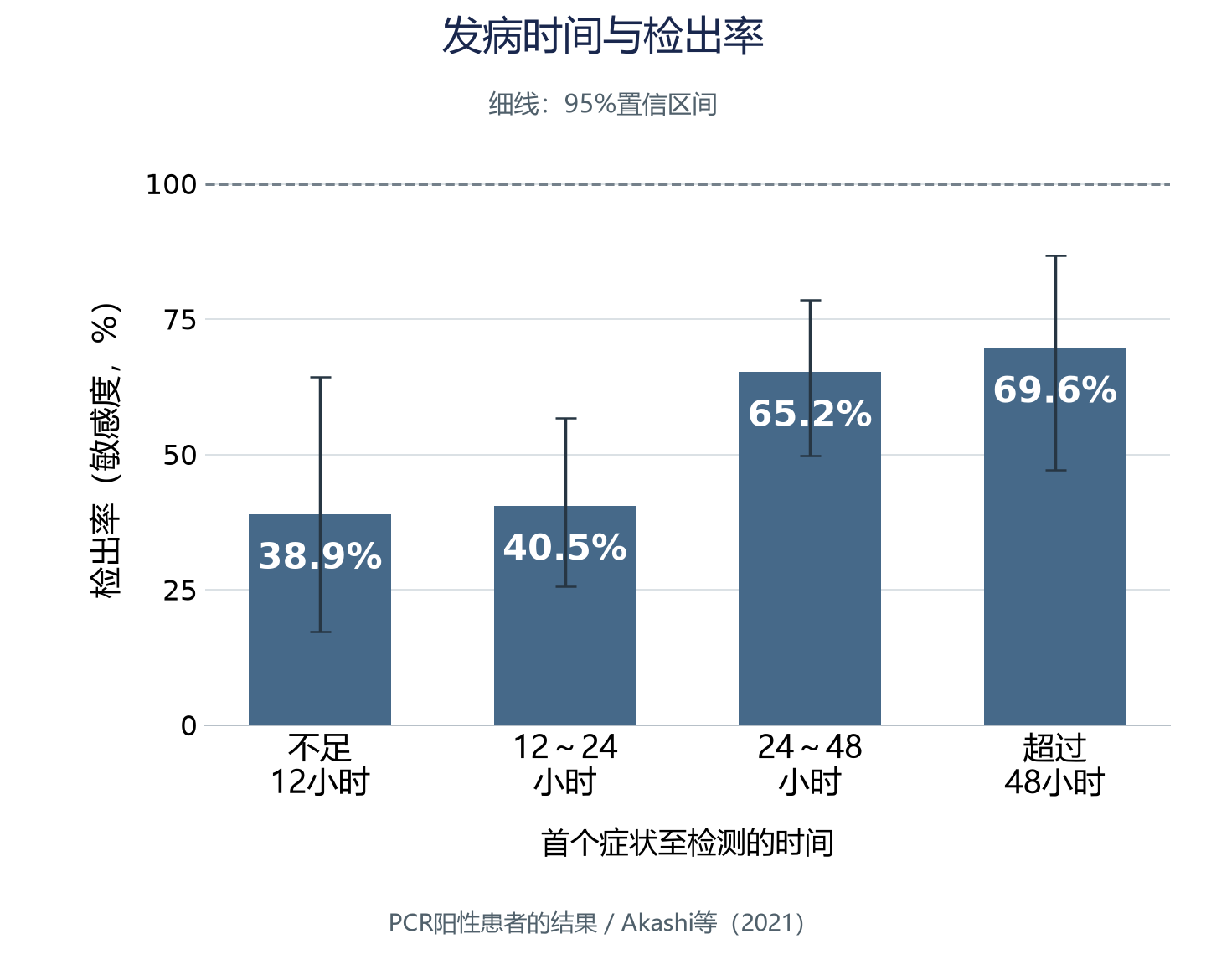
研究于2017~2019年流感季在筑波医疗中心医院进行,分析313人,其中129人PCR阳性,采用鼻咽标本进行快速抗原检测。
| 发病后的时间 | 检出率(95%置信区间) |
|---|---|
| 不足12小时 | 38.9% 17.3~64.3% |
| 12~24小时 | 40.5% 25.6~56.7% |
| 24~48小时 | 65.2% 49.8~78.6% |
| 超过48小时 | 69.6% 47.1~86.8% |
数据是各时间组PCR阳性患者中抗原检出的比例,各组由不同患者组成。95%置信区间表示估计范围。
有时不应等待复查
呼吸困难、反应异常、喝不进水且尿量减少,或好转后发热咳嗽再次恶化时,应及时就医,不要等原定复查。[4]
老年人、孕妇、幼儿和有基础疾病者应尽早咨询。抗流感药通常重视早期使用,医生可能根据症状与风险,在阴性时仍考虑治疗。目的不是一直等到阳性。[3][4]
阴性后,病程观察和必要时复查很重要
经过半天至一天检测,仍可能是阴性。如果发热或症状持续,请再次就诊。医生会查看前后变化,根据需要安排进一步检测或治疗。[2]
医生会根据需要间隔后再次检测、采用其他方法或评估其他疾病。第二天转为阳性本身不能证明首次采样不当。[2]
阴性之后的确认
- 首次就诊结合结果确认起病时间、症状和基础疾病。
- 观察变化记录发热、呼吸和饮水等变化。
- 必要时复诊医生判断是否复查、改用其他检测或治疗。
是否、何时和如何复查,由症状、首次检测后的间隔、基础疾病及治疗需要决定。
请说明最初症状、发热和检测的时间,以及体温、饮水和呼吸的变化。重点是结合受诊时的结果与之后病程,而不是一直等到某个保证结果确定的时刻。
参考资料
- 明石祐作ほか.発症から検査までの時間がインフルエンザ迅速抗原検査に与える影響:前向き観察研究.感染症学雑誌 2021;95:9–16(Table 2A)
- CDC. Rapid Influenza Diagnostic Tests
- CDC. Influenza Antiviral Medications: Summary for Clinicians
- CDC. Signs and Symptoms of Flu
- Yu SH et al. Performance evaluation of the Panbio COVID-19/Flu A&B Panel using mid-turbinate nasal swabs. J Clin Microbiol. 2024. DOI: 10.1128/jcm.00207-24
- Seki Y et al. Very high sensitivity of a rapid influenza diagnostic test in adults and elderly individuals within 48 hours of the onset of illness. PLoS One. 2020;15:e0231217
- Mikamo H et al. Comparing the cobas Influenza A/B Nucleic acid test for use on the cobas Liat System with rapid antigen tests for clinical management of Japanese patients at the point of care. PLoS One. 2022;17:e0276099(Table 3)
Fuentes revisadas: 15 de octubre de 2026
La detección cambia con el tiempo desde el inicio. A partir de estudios que evaluaron varios kits de antígeno juntos, explicamos el momento de la prueba, cómo contar el inicio y qué hacer tras un negativo.
Con el tiempo pueden detectarse más infecciones
● + Rojo: detectado
○ − Azul: no detectado
Al comenzar los síntomas
Puede ser difícil detectar aún
Dentro de 12 horas
Aumentan los positivos
Dentro de 24 horas
Pueden detectarse más casos
Dentro de 48 horas
Algunas pruebas siguen negativas
Si persisten síntomas tras un negativo, vuelva a consultar y repita la prueba cuando sea necesario.
Detección por tiempo al evaluar varios kits juntos
Un estudio japonés en un hospital y tres clínicas evaluó conjuntamente seis kits de antígeno rápido. Analizó 413 personas y midió la detección entre infecciones confirmadas por gripe A según el tiempo.[7]
- Menos de 12 horas: 75,6% (96/127)
- 12–24 horas: 89,4% (42/47)
- 24–48 horas: 82,6% (19/23)
En ese estudio, se detectó aproximadamente el 70–80% antes de medio día y el 80–90% entre medio día y dos días. Influyen el tiempo, la intensidad de los síntomas y la toma de la muestra.[7]
Junto con otros estudios, muestra que una prueba temprana puede ser negativa y algunas infecciones se detectan después. Cambian población y definición del inicio. Use medio día a un día como referencia y valore el resultado con la evolución posterior.[1][5][6][7]
Una referencia práctica: medio día a un día después
Con síntomas leves y situación estable, sugerimos planificar el antígeno tras al menos medio día (12 horas), preferiblemente cerca de un día (24 horas), como referencia. Al principio puede haber poca cantidad viral detectable. [2][7]
Mayores, embarazadas, niños pequeños, personas con enfermedades previas o síntomas intensos deben consultar sin esperar ese tiempo. Importa el tratamiento antiviral temprano; no lo retrase por ajustarse al horario de una prueba.[3][4]
Contar desde la fiebre no es lo mismo que desde el primer síntoma
El inicio de la fiebre suele ser fácil de recordar, pero un dolor de garganta leve o cansancio pueden aparecer antes. Doce horas desde un síntoma leve no equivalen a doce horas desde la fiebre.
Ejemplo
Dolor de garganta leve a las 8:00, fiebre a las 16:00 y prueba a las 20:00: han pasado 12 horas desde el dolor, pero solo 4 desde la fiebre.
Aunque haya pasado medio día desde el dolor, la fiebre acaba de empezar y puede que aún no haya suficiente virus para detectarlo con antígeno.
Indique a la clínica por separado cuándo empezó el primer síntoma y cuándo apareció la fiebre.
Desde los síntomas leves, el tiempo hasta un positivo puede ser más largo
Si el dolor de garganta precede a la fiebre, contar desde ese síntoma anterior alarga el tiempo medido hasta un positivo. Medio día desde una molestia leve no significa necesariamente que ya sea fácil detectar la infección. Con síntomas leves y situación estable, tenga en cuenta el inicio de la fiebre y la evolución para planificar la prueba.
Akashi y colaboradores contaron desde el primer síntoma, como dolor de garganta, tos o cansancio, no solo desde la fiebre. Con esa definición, el antígeno detectó más infecciones en los grupos examinados después de 24 horas.[1]
La idea práctica es que contar desde síntomas leves incluye el período anterior a la fiebre. Si persisten fiebre o síntomas tras un negativo, vuelva a consultar y repita la prueba cuando sea necesario.
Ampliación: gráfica y datos contados desde el primer síntoma
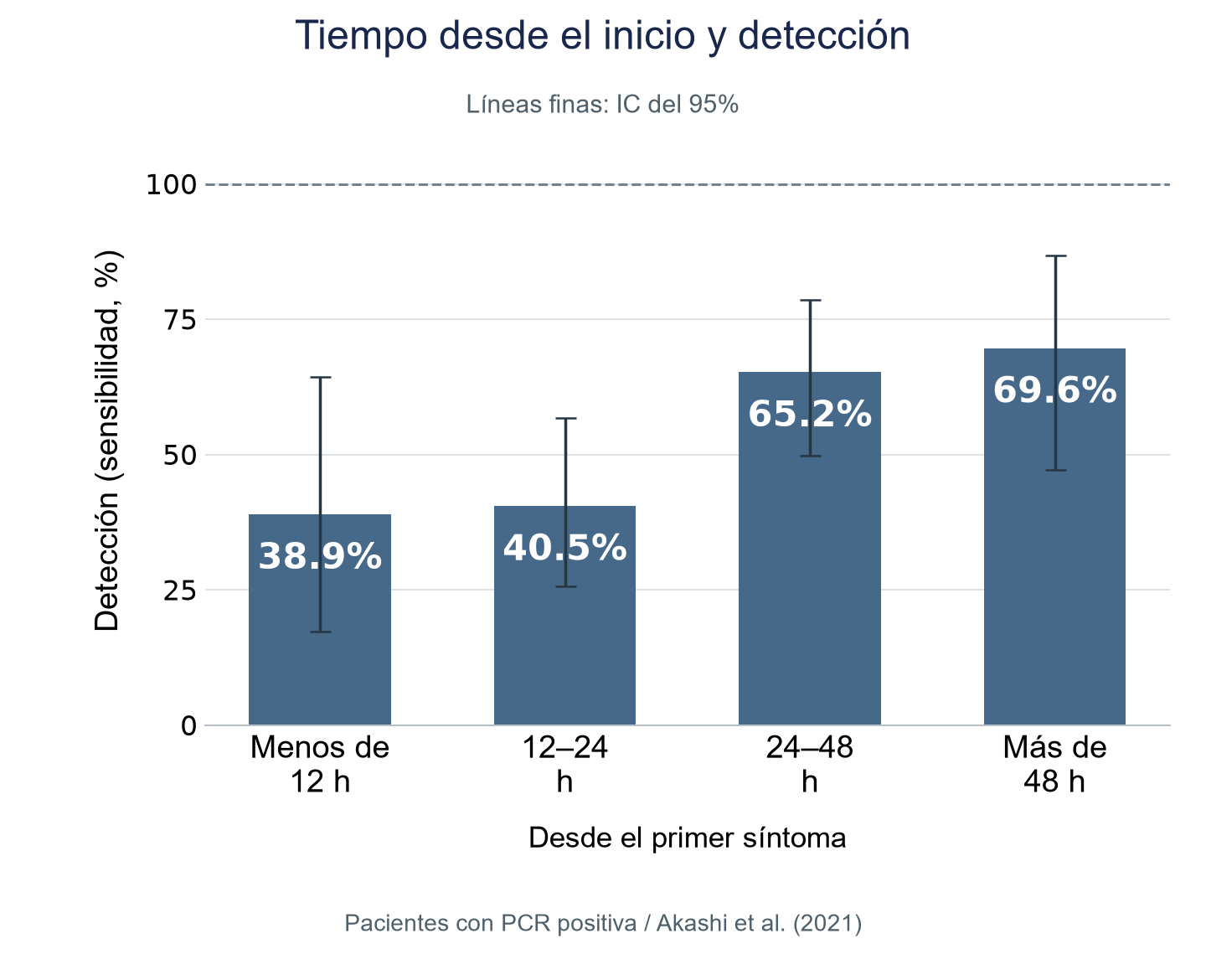
Estudio del Tsukuba Medical Center Hospital durante las temporadas 2017–2019. Se analizaron 313 personas, 129 con PCR positiva, utilizando muestras nasofaríngeas para antígeno rápido.
| Tiempo desde el inicio | Detección (IC del 95%) |
|---|---|
| Menos de 12 h | 38.9% 17.3~64.3% |
| 12–24 h | 40.5% 25.6~56.7% |
| 24–48 h | 65.2% 49.8~78.6% |
| Más de 48 h | 69.6% 47.1~86.8% |
Son tasas de detección por antígeno entre pacientes con PCR positiva de distintos grupos horarios. El IC del 95% muestra el intervalo de incertidumbre.
A veces no conviene esperar otra prueba
Consulte pronto ante dificultad respiratoria, alteración de la alerta, imposibilidad de beber con poca orina, o fiebre/tos que vuelven o empeoran tras mejorar. No espere a la cita de repetición.[4]
Mayores, embarazadas, niños pequeños y personas con enfermedades previas deben consultar temprano. Importa iniciar pronto el antiviral; el médico puede tratar una gripe sospechada pese al negativo según síntomas y riesgo. No se busca esperar hasta que salga positiva.[3][4]
Tras un negativo, importan la evolución y la reevaluación
Una prueba puede ser negativa incluso tras 12–24 horas. Si persisten fiebre o síntomas, vuelva a consultar. Se revisarán los cambios desde la primera visita y la necesidad de nuevas pruebas o tratamiento.[2]
El médico puede repetir tras un intervalo, elegir otro método o valorar otras enfermedades. Un positivo al día siguiente no demuestra por sí solo una primera toma incorrecta.[2]
Después de un resultado negativo
- Consulta inicialRevisar inicio, síntomas y enfermedades junto al resultado.
- Observar la evoluciónAnotar fiebre, respiración e ingesta de líquidos.
- Reevaluar si hace faltaEl médico decide nuevas pruebas y tratamiento.
Los síntomas, el intervalo, las enfermedades previas y la necesidad de tratamiento orientan si se repite, cuándo y cómo.
Indique los horarios del primer síntoma, la fiebre y la prueba, y los cambios de temperatura, líquidos y respiración. Importa usar el resultado inicial con la evolución posterior, no seguir esperando un momento que garantice certeza.
Referencias
- 明石祐作ほか.発症から検査までの時間がインフルエンザ迅速抗原検査に与える影響:前向き観察研究.感染症学雑誌 2021;95:9–16(Table 2A)
- CDC. Rapid Influenza Diagnostic Tests
- CDC. Influenza Antiviral Medications: Summary for Clinicians
- CDC. Signs and Symptoms of Flu
- Yu SH et al. Performance evaluation of the Panbio COVID-19/Flu A&B Panel using mid-turbinate nasal swabs. J Clin Microbiol. 2024. DOI: 10.1128/jcm.00207-24
- Seki Y et al. Very high sensitivity of a rapid influenza diagnostic test in adults and elderly individuals within 48 hours of the onset of illness. PLoS One. 2020;15:e0231217
- Mikamo H et al. Comparing the cobas Influenza A/B Nucleic acid test for use on the cobas Liat System with rapid antigen tests for clinical management of Japanese patients at the point of care. PLoS One. 2022;17:e0276099(Table 3)
자료 확인: 2026년 10월 15일
검출되는 비율은 발병 후 시간에 따라 달라집니다. 여러 항원 키트를 함께 평가한 연구를 바탕으로 검사 시점, 발병 시간 계산, 음성 후 대응을 설명합니다.
시간이 지나면서 검출되는 사람이 늘어납니다
● + 빨강: 검출됨
○ − 파랑: 검출되지 않음
증상이 막 시작됐을 때
아직 검출이 어려울 수 있습니다
12시간 이내
양성이 나오는 사람이 늘어납니다
24시간 이내
더 많은 감염자가 검출됩니다
48시간 이내
시간이 지나도 음성일 수 있습니다
음성 후에도 증상이 계속되면 재진하고 필요하면 재검합니다.
여러 키트를 함께 평가한 시간대별 검출률
일본 병원 1곳과 진료소 3곳에서 신속항원 키트 6종을 함께 평가한 연구가 있습니다. 413명을 분석하고 A형 독감이 확인된 환자 중 항원으로 검출된 비율을 시간대별로 조사했습니다.[7]
- 12시간 미만: 75.6% (96/127)
- 12~24시간: 89.4% (42/47)
- 24~48시간: 82.6% (19/23)
이 연구에서는 반나절 전 약 70~80%, 반나절~이틀 사이 약 80~90%가 검출됐습니다. 시간·증상의 심한 정도·검체 채취 상태도 실제 검출률에 영향을 줍니다.[7]
다른 연구와 함께 보면 초기에는 음성일 수 있고 시간이 지나 검출되는 환자도 있습니다. 대상 환자와 발병 시간의 정의가 다르므로 반나절~하루를 기준으로 결과와 이후 경과를 함께 판단합니다.[1][5][6][7]
검사 시점의 기준: 반나절~하루 후
증상이 가볍고 상태가 안정적이면 발병 후 적어도 반나절(12시간), 가능하면 하루(24시간) 전후로 항원검사를 계획하는 것을 기준으로 권합니다. 초기에는 바이러스 양이 적어 검출이 어려울 수 있습니다. [2][7]
고령자·임신부·어린아이·기저질환자 또는 증상이 심한 분은 이 시간을 기다리지 말고 상담하세요. 항바이러스 치료는 조기 시작이 중요해 검사 시각 때문에 필요한 치료를 늦추지 않아야 합니다.[3][4]
발열부터 센 시간과 첫 증상부터 센 시간은 다릅니다
열이 시작된 시각은 기억하기 쉽지만 가벼운 인후통이나 피로가 먼저 나타날 수 있습니다. 가벼운 증상부터 12시간과 발열부터 12시간은 다릅니다.
시간 계산의 예
오전 8시에 가벼운 인후통, 오후 4시에 발열, 오후 8시에 검사했다면 인후통부터는 12시간이지만 발열부터는 4시간입니다.
이 예에서는 인후통이 반나절 됐어도 열이 난 지는 얼마 되지 않아 항원으로 검출할 만큼 바이러스가 늘지 않았을 수 있습니다.
진료 시 첫 증상이 나타난 시각과 열이 난 시각을 나누어 알려 주세요.
가벼운 증상부터 세면 양성까지 더 오래 걸릴 수도 있습니다
인후통이 발열보다 먼저 나타났다면 그때부터 센 양성까지의 시간도 길어집니다. 가벼운 증상부터 반나절 지났다고 충분히 검출될 시점인 것은 아닙니다. 증상이 가볍고 안정적이면 발열 시각과 이후 증상 변화를 함께 보고 검사 시점을 정합니다.
Akashi 등의 일본 연구는 발열뿐 아니라 인후통·기침·피로 등 첫 증상부터 시간을 셌습니다. 이 기준에서 24시간 이후 검사한 군은 더 많은 감염자가 항원 양성이었습니다.[1]
진료에 적용할 점은 가벼운 증상부터 센 시간에는 발열 전 시간도 포함된다는 것입니다. 첫 검사 음성 후 열이나 증상이 지속되면 경과를 다시 확인하고 필요하면 재검합니다.
보충: 첫 증상부터 시간을 센 연구의 그래프와 자료
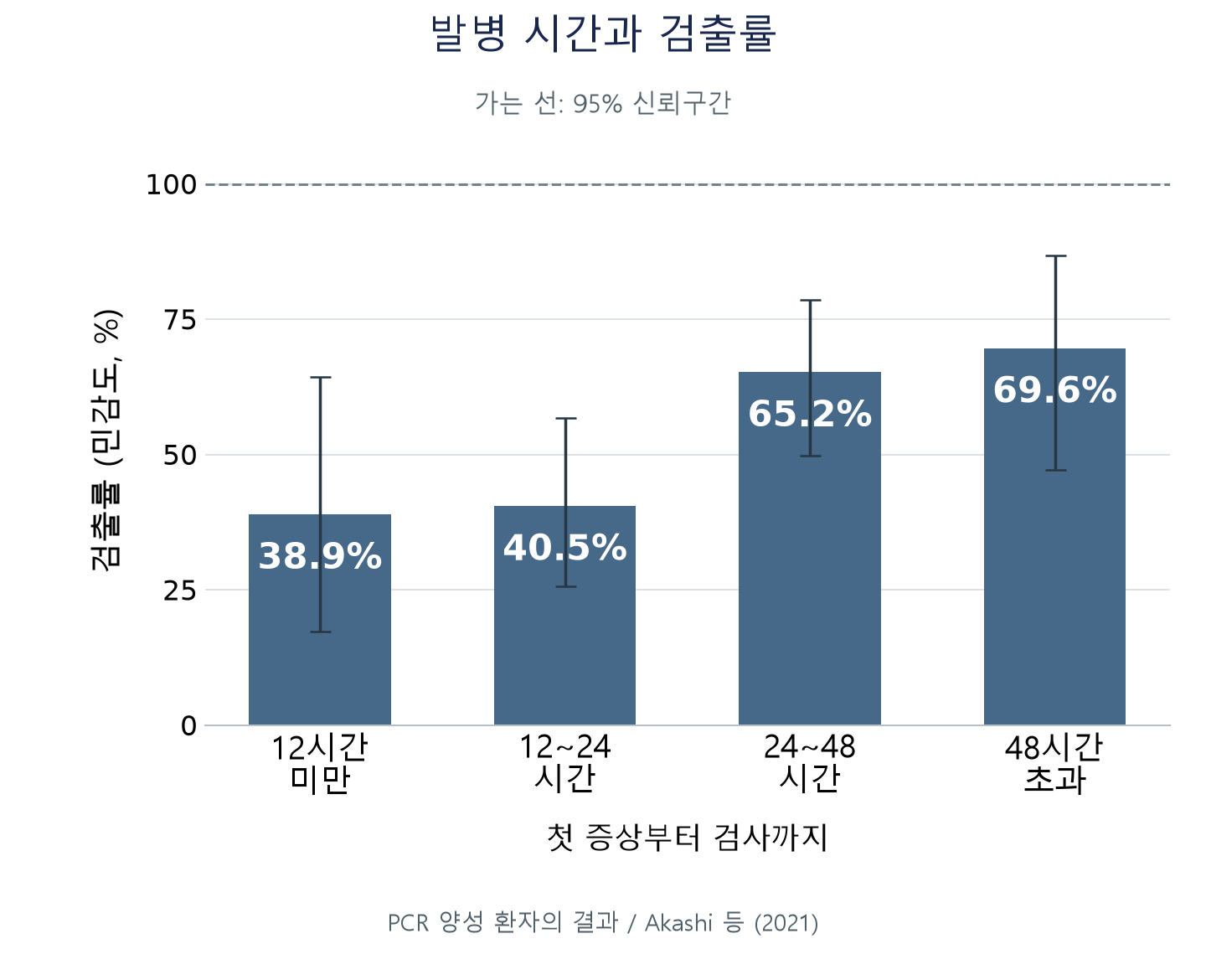
2017~2019년 유행기에 쓰쿠바 메디컬센터 병원에서 시행한 연구입니다. 313명 중 129명이 PCR 양성이었으며 비인두 검체로 신속항원검사를 시행했습니다.
| 발병 후 시간 | 검출률 (95% 신뢰구간) |
|---|---|
| 12시간 미만 | 38.9% 17.3~64.3% |
| 12~24시간 | 40.5% 25.6~56.7% |
| 24~48시간 | 65.2% 49.8~78.6% |
| 48시간 초과 | 69.6% 47.1~86.8% |
각 시간대의 PCR 양성 환자에서 항원이 검출된 비율입니다. 서로 다른 환자군을 시간대별로 비교하며 95% 신뢰구간은 추정 범위를 나타냅니다.
재검을 기다리지 말아야 할 때도 있습니다
숨이 차거나 반응이 이상하고, 물을 못 마시면서 소변이 줄거나, 호전 뒤 열·기침이 다시 악화하면 예정된 재검을 기다리지 말고 진료받으세요.[4]
고령자·임신부·어린아이·기저질환자는 일찍 상담하세요. 항바이러스 치료는 조기 시작이 중요하며 의사가 증상과 위험에 따라 음성이라도 치료를 고려할 수 있습니다. 양성이 될 때까지 기다리는 것이 목적이 아닙니다.[3][4]
음성 후에는 경과 확인과 필요한 재검이 중요합니다
반나절~하루 후 검사해도 음성일 수 있습니다. 열이나 증상이 계속되면 다시 진료받으세요. 첫 진료 이후 변화를 확인해 필요한 추가 검사와 치료를 결정합니다.[2]
의사는 필요에 따라 간격을 둔 재검·다른 검사 또는 다른 질환 평가를 검토합니다. 다음 날 양성이라는 변화만으로 첫 채취가 잘못됐다고 판단할 수 없습니다.[2]
음성 이후 확인할 사항
- 첫 진료결과와 함께 발병 시각·증상·기저질환 확인.
- 경과 확인열·호흡·수분 섭취의 변화를 기록.
- 필요하면 재진의사가 재검·다른 검사·치료를 판단.
증상·첫 검사 후 시간·기저질환·치료 필요성에 따라 재검 여부와 시기·방법을 결정합니다.
첫 증상·발열·검사 시각과 체온·수분 섭취·호흡 변화를 알려 주세요. 확실한 결과가 보장되는 시각을 기다리는 것보다 초기 결과와 이후 경과를 진료에 연결하는 것이 중요합니다.
참고 자료
- 明石祐作ほか.発症から検査までの時間がインフルエンザ迅速抗原検査に与える影響:前向き観察研究.感染症学雑誌 2021;95:9–16(Table 2A)
- CDC. Rapid Influenza Diagnostic Tests
- CDC. Influenza Antiviral Medications: Summary for Clinicians
- CDC. Signs and Symptoms of Flu
- Yu SH et al. Performance evaluation of the Panbio COVID-19/Flu A&B Panel using mid-turbinate nasal swabs. J Clin Microbiol. 2024. DOI: 10.1128/jcm.00207-24
- Seki Y et al. Very high sensitivity of a rapid influenza diagnostic test in adults and elderly individuals within 48 hours of the onset of illness. PLoS One. 2020;15:e0231217
- Mikamo H et al. Comparing the cobas Influenza A/B Nucleic acid test for use on the cobas Liat System with rapid antigen tests for clinical management of Japanese patients at the point of care. PLoS One. 2022;17:e0276099(Table 3)
資料確認:2026年10月15日
検査で分かる割合は、発症からの時間によって変わります。複数のキットをまとめて評価した研究をもとに、検査の目安、発症時間の数え方、陰性だったあとの対応を説明します。
時間がたつと、検査で見つかる人が増えていきます
● + 赤:検出できた人
○ − 青:検出できなかった人
症状が出た直後
まだ見つかりにくい時期
12時間以内
陽性になる人が増えてきます
24時間以内
さらに見つかりやすくなります
48時間以内
時間がたっても陰性の人がいます
陰性でも症状が続くときは、経過をみて再診・必要な再検査を。
複数のキットをまとめた、時間別の検出率
国内の病院1施設・クリニック3施設で、6種類の迅速抗原検査をまとめて評価した研究があります。413人を解析し、A型インフルエンザが確認された人のうち、抗原検査で検出できた割合を、発症からの時間ごとに調べています。[7]
- 12時間未満:75.6%(127人中96人)
- 12〜24時間:89.4%(47人中42人)
- 24〜48時間:82.6%(23人中19人)
この研究では、発症から半日未満で約7〜8割、半日〜2日では約8〜9割が検出されています。検出率は、時間や症状の強さ、検体の採取状態なども含めた診療の条件によって変わります。[7]
ほかの研究も合わせて読むと、発症して間もない時期には陰性になることがあり、時間をおいて検出される方がいることが分かります。研究ごとの患者さんや発症時間の数え方には違いがあるため、半日〜1日を目安に、結果とその後の経過を合わせて判断します。[1][5][6][7]
検査の目安は、半日〜1日後
症状が軽く、状態が安定している方が検査の予定を立てるなら、発症から半日(12時間)以上、できれば1日(24時間)前後を一つの目安としてお勧めします。発症直後はウイルスの量が少なく、抗原検査で捉えにくい場合があるためです。[2][7]
高齢の方、妊娠中の方、小さなお子さん、持病がある方や、症状が強い方は、この時間を待たずに相談してください。抗ウイルス薬は早い開始が重視されるため、検査の時刻にこだわって必要な治療を遅らせないことが大切です。[3][4]
医療者が押さえておきたい研究の条件
Mikamo研究のA型抗原感度の95%信頼区間は、12時間未満67.4〜82.2%、12〜24時間77.4〜95.4%、24〜48時間62.9〜93.0%です。6種類の抗原キットをまとめ、分子検査との結果が一致しない検体のみ別のPCRで確認した解析です。後半の群が少数、B型は1例、Rocheからの資金提供という条件があります。同一患者の連日検査ではなく、12時間を境とする全員への一律の待機指示や、24時間が最適という断定の根拠にはできません。[7]
「発熱から」と「最初の症状から」は違います
発熱は始まった時刻が分かりやすい症状ですが、その前から少し喉が痛い、だるいと感じることもあります。軽い症状から数えた12時間と、発熱から数えた12時間は、同じではありません。
時間の数え方の例
朝8時に少し喉が痛くなり、午後4時に発熱。午後8時に検査した場合、喉の痛みからは12時間ですが、発熱からはまだ4時間です。
この例では、喉の痛みから半日たっていても、発熱してからは間もないため、抗原検査で捉えられる量のウイルスがまだ十分に増えていないことがあります。
受診時には、最初に体調の変化を感じた時刻と、熱が出た時刻を分けて伝えてください。
軽い症状から数えると、陽性になるまで長くかかることも
喉の痛みなどが発熱より先に出た場合、そこから数えると、検査が陽性になるまでの時間も長くなります。「軽い症状から半日たったから、もう十分に検出できるはず」とは限りません。症状が軽く安定している方では、発熱した時刻や、その後の症状の変化も踏まえて検査の時期を考えます。
明石らの国内研究も、発熱だけでなく、喉の痛みや咳、だるさなど最初の症状から時間を数えています。その数え方では、24時間以降の群で、より多くの感染者が抗原検査で陽性になっていました。[1]
この研究から日常の受診に生かしたいのは、軽い症状から数えた時間には、発熱前の時間も含まれるという点です。初回の検査が陰性でも、熱や症状が続く場合は、その後の経過を確認し、必要に応じて再検査します。
補足:最初の症状から時間を数えた研究のグラフとデータ
| 発症からの時間 | 検出率(95%信頼区間) |
|---|---|
| 12時間未満 | 38.9% 17.3~64.3% |
| 12~24時間 | 40.5% 25.6~56.7% |
| 24~48時間 | 65.2% 49.8~78.6% |
| 48時間超 | 69.6% 47.1~86.8% |
各時間帯のPCR陽性患者で、抗原検査が検出した割合です。異なる患者群を時間帯ごとに比較しています。95%信頼区間は推定の幅を示します。
問診と説明に生かすには
最初の症状、発熱、検査の3つの時刻を確認し、「発症から何時間」の起点をそろえます。明石研究は初発症状を起点とした時間群を比較したもので、同じ患者について発熱起点に置き換えた感度を算出した研究ではありません。患者への説明では、早い時点から数えた時間と、発熱後の時間の違いを具体例で示します。症状と全身状態を評価し、必要な再診・再検査につなげます。[1]
治療や安全確認を、再検査より後に置きません
重症・進行性、入院が必要な状態、重症化リスクが高い患者では、必要な抗ウイルス治療を検査結果待ちで遅らせないという考え方があります。一般に発症48時間以内の開始で効果が期待されますが、重症例等では48時間を超えても治療を検討します。薬剤・適応・用量は個別に判断します。[3]
低酸素が疑われる呼吸症状、反応の低下、脱水、一旦改善後の再悪化は、診断名の確定より先に評価すべき事項です。[4]
陰性だったら、その後の経過と再検査が大切です
半日〜1日たって検査しても、陰性になることがあります。熱や症状が続く場合は、もう一度受診してください。前回からの変化を確認し、必要な再検査や治療につなげます。[2]
再診では、必要に応じて時間をおいた再検査や別の検査方法を検討し、ほかの病気も含めて評価します。翌日に陽性になったという変化だけで、最初の採取が悪かったとは判断できません。[2]
陰性だったあとの確認
- 初回の診察結果とともに、発症時刻・症状・持病を確認。
- 経過を確認熱・呼吸・水分摂取などの変化を記録。
- 必要な方は再診再検査・別の検査・治療を医師が判断。
再検査の時期や方法は、症状、初回検査からの時間、持病や治療の必要性を合わせて決めます。
最初の症状、発熱、検査の時刻と、その後の体温・水分摂取・呼吸の変化を伝えてください。大切なのは、確実な結果が出る時刻を待ち続けることではなく、受診時の結果と、その後の経過を診療につなげることです。
参考資料
- 明石祐作ほか.発症から検査までの時間がインフルエンザ迅速抗原検査に与える影響:前向き観察研究.感染症学雑誌 2021;95:9–16(Table 2A)
- CDC. Rapid Influenza Diagnostic Tests
- CDC. Influenza Antiviral Medications: Summary for Clinicians
- CDC. Signs and Symptoms of Flu
- Yu SH et al. Performance evaluation of the Panbio COVID-19/Flu A&B Panel using mid-turbinate nasal swabs. J Clin Microbiol. 2024. DOI: 10.1128/jcm.00207-24
- Seki Y et al. Very high sensitivity of a rapid influenza diagnostic test in adults and elderly individuals within 48 hours of the onset of illness. PLoS One. 2020;15:e0231217
- Mikamo H et al. Comparing the cobas Influenza A/B Nucleic acid test for use on the cobas Liat System with rapid antigen tests for clinical management of Japanese patients at the point of care. PLoS One. 2022;17:e0276099(Table 3)
Sources checked: 15 October 2026
Detection changes with time from onset. Using research that assessed several antigen kits together, we explain practical timing, how onset is counted, and what to do after a negative result.
More infections may be detected as time passes
● + Red: detected
○ − Blue: not detected
Just after symptoms start
Detection may still be difficult
Within 12 hours
More tests become positive
Within 24 hours
More infections may be found
Within 48 hours
Some tests can remain negative
If symptoms persist after a negative result, seek reassessment and repeat testing when needed.
Detection over time across several test kits
A Japanese study at one hospital and three clinics assessed six rapid antigen kits together. It analysed 413 people and measured detection among confirmed influenza A infections by time from onset.[7]
- Under 12 hours: 75.6% (96/127)
- 12–24 hours: 89.4% (42/47)
- 24–48 hours: 82.6% (19/23)
In this study, detection was roughly 70–80% before half a day and 80–90% between half a day and two days. Time, symptom severity and specimen collection all contribute to the observed rate.[7]
Read alongside other studies, these findings show that early tests can be negative and some infections become detectable later. Study populations and onset definitions vary. Use half a day to one day as a guide, and interpret results with the subsequent course.[1][5][6][7]
A practical guide: half a day to one day after onset
If symptoms are mild and your condition is stable, we suggest planning an antigen test after at least half a day (12 hours), preferably around one day (24 hours), as a practical guide. Very early viral amounts may be harder to detect. [2][7]
Older people, pregnant people, young children, people with underlying conditions or severe symptoms should seek advice without waiting for that time. Early antiviral treatment matters; do not delay needed treatment to fit a testing clock.[3][4]
Study conditions for clinical interpretation
In Mikamo et al., antigen influenza A sensitivity 95% CIs were 67.4–82.2% before 12 hours, 77.4–95.4% at 12–24 hours, and 62.9–93.0% at 24–48 hours. Six antigen kits were pooled; only discordant molecular/antigen results were adjudicated with another PCR assay. Later groups were small, influenza B had one case, and Roche funded the study. These are different patient groups, not serial testing of individuals, and do not establish a universal waiting rule or 24-hour optimum.[7]
Time from fever and time from the first symptom are different
Fever often has a clear starting time, but a mild sore throat or fatigue may come first. Twelve hours from a mild symptom is not the same as twelve hours from fever.
An example
A mild sore throat starts at 8 am, fever at 4 pm, and testing takes place at 8 pm. That is 12 hours from the sore throat, but only 4 hours from fever.
In this example, half a day has passed since the sore throat, yet fever has only recently begun. There may still be too little virus for an antigen test to detect.
Tell the clinic when the first symptom started and when fever began, separately.
Counting from mild symptoms can mean a longer time until a positive test
If a sore throat precedes fever, counting from that earlier symptom makes the measured time until a positive test longer. Half a day after a mild symptom does not necessarily mean enough time has passed for detection. For mild, stable illness, consider fever onset and the subsequent course when planning testing.
Akashi and colleagues counted from the first symptom, including sore throat, cough or fatigue, rather than fever alone. With that definition, antigen testing detected more infections in groups tested after 24 hours.[1]
The practical point is that time counted from a mild symptom includes the period before fever. If an initial test is negative and fever or symptoms persist, reassess the course and repeat testing when needed.
Further reading: graph and data counted from the first symptom
| Time from onset | Detection (95% confidence interval) |
|---|---|
| Under 12 h | 38.9% 17.3~64.3% |
| 12–24 h | 40.5% 25.6~56.7% |
| 24–48 h | 65.2% 49.8~78.6% |
| Over 48 h | 69.6% 47.1~86.8% |
These are antigen detection rates among PCR-positive patients in different time groups. The 95% confidence intervals show the range of uncertainty.
Using this in assessment and explanations
Record three times: first symptom, fever onset and testing. Establish which starting point is used. Akashi et al. compared groups timed from the first symptom; they did not recalculate sensitivity from fever onset in the same patients. Use the example to explain the two clocks, then assess symptoms and overall condition to plan reassessment and further testing when needed.[1]
Do not put treatment and safety after repeat testing
For severe/progressive illness, hospitalised patients and high-risk patients, indicated antiviral treatment should not be delayed awaiting confirmation. Starting within 48 hours generally offers greatest benefit; severe cases may still warrant treatment later. Choose drug, indication and dose individually.[3]
Concerning respiratory symptoms, reduced responsiveness, dehydration and worsening after initial improvement warrant evaluation before pursuing a definite test label.[4]
After a negative result, follow the course and reassess
A test can be negative even after 12–24 hours. If fever or symptoms persist, arrange another assessment. Review changes since the first visit and decide on further testing or treatment when needed.[2]
The clinician may choose repeat testing after an interval, another method or assessment for other illnesses. A positive result the next day does not alone prove that the first sample was collected poorly.[2]
After a negative result
- Initial assessmentReview onset, symptoms and underlying conditions with the result.
- Follow the courseRecord fever, breathing and fluid intake.
- Reassessment if neededThe clinician decides on repeat or different tests and treatment.
Symptoms, time since the first test, underlying conditions and treatment needs determine whether, when and how to retest.
Report first-symptom, fever and test times, together with changes in temperature, fluids and breathing. The aim is to use the initial result and subsequent course in care, rather than keep waiting for a moment of guaranteed certainty.
References
- 明石祐作ほか.発症から検査までの時間がインフルエンザ迅速抗原検査に与える影響:前向き観察研究.感染症学雑誌 2021;95:9–16(Table 2A)
- CDC. Rapid Influenza Diagnostic Tests
- CDC. Influenza Antiviral Medications: Summary for Clinicians
- CDC. Signs and Symptoms of Flu
- Yu SH et al. Performance evaluation of the Panbio COVID-19/Flu A&B Panel using mid-turbinate nasal swabs. J Clin Microbiol. 2024. DOI: 10.1128/jcm.00207-24
- Seki Y et al. Very high sensitivity of a rapid influenza diagnostic test in adults and elderly individuals within 48 hours of the onset of illness. PLoS One. 2020;15:e0231217
- Mikamo H et al. Comparing the cobas Influenza A/B Nucleic acid test for use on the cobas Liat System with rapid antigen tests for clinical management of Japanese patients at the point of care. PLoS One. 2022;17:e0276099(Table 3)